KEEP LEARNING
Build the bigger picture.
The Workflow Engineer connects individual n8n concepts to testing, deployment and running a complete workflow.
Showcase > Research & Data
48-node n8n workflow with DataForSEO, Mistral, Anthropic, and SerpAPI for keyword, product, and Amazon market research.
This 48-node system combines three webhook-triggered sub-workflows -- keyword research, product evaluation, and Amazon marketplace intelligence -- into one product-research toolkit. Each pipeline can run independently or chain together. It pulls real search volume from DataForSEO, evaluates products with Brave Search, queries Amazon via SerpAPI, and uses Mistral for fast analysis and Anthropic Claude for deeper reasoning, writing results to Google Sheets.
A 48-node research system built from three interconnected sub-workflows that turn raw market data into actionable product intelligence. This is what product research looks like when you stop guessing and start building systems. Each sub-workflow handles a distinct research dimension -- keyword analysis, product evaluation, and Amazon marketplace intelligence -- and all three can be triggered independently or chained together for comprehensive market analysis.
| Nodes | Category | Complexity | Key Integrations |
|---|---|---|---|
| 48 | Research & Analysis | Advanced | DataForSEO, Mistral, Anthropic, SerpAPI, Brave Search, Google Sheets |
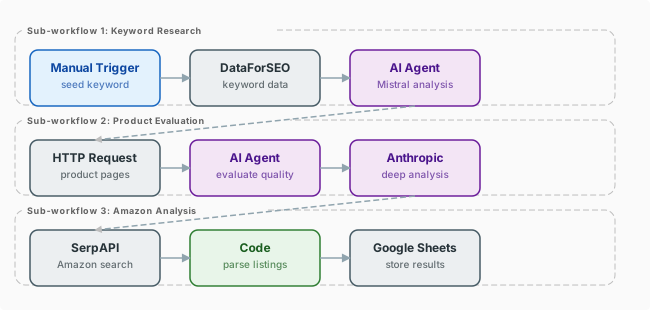
This workflow system provides three distinct research pipelines, each accessible via its own webhook endpoint. The first pipeline pulls real search volume data from DataForSEO and runs it through AI analysis to identify high-opportunity keywords. The second uses AI agents armed with Brave Search to evaluate specific products against market conditions. The third queries Amazon directly via SerpAPI and layers AI-powered insights on top of the raw results.
What makes this system powerful is the dual-model AI architecture. Mistral handles rapid-fire analysis tasks where speed matters, while Anthropic Claude steps in for nuanced evaluation that requires deeper reasoning. Each model is deployed where its strengths align with the task, not as an afterthought.
All three pipelines write structured results to Google Sheets, building a persistent research database that grows more valuable with every execution. The webhook triggers mean any external tool -- a Slack bot, a custom dashboard, or another n8n workflow -- can kick off research on demand.
DataForSEO for real search volume data. Unlike workflows that rely on AI to estimate search volume, this system pulls actual search data from DataForSEO. Real numbers, not hallucinated estimates. This single integration elevates the entire research output from "interesting guesses" to "data-backed decisions."
Three distinct webhook-triggered pipelines. Each research dimension is independently callable. You can run keyword research on Monday, product evaluation on Wednesday, and Amazon analysis on Friday -- or trigger all three simultaneously for a complete market picture.
Mistral plus Anthropic dual-model architecture. This system strategically deploys two different AI models based on task requirements. Mistral handles high-throughput analysis where speed matters. Anthropic Claude handles nuanced evaluation where depth of reasoning matters. The result is faster and smarter than either model alone.
Triggers
AI & Language Models
Research & Data
Storage & Logic
Webhook Entry -- One of three webhook endpoints receives a research request. Each endpoint corresponds to a distinct pipeline: keyword research, product evaluation, or Amazon analysis.
Pipeline 1: Keyword Research -- DataForSEO pulls real search volume, CPC, and competition data for the target keywords. Mistral analyzes the raw data to identify high-opportunity terms with strong volume-to-competition ratios.
Pipeline 2: Product Evaluation -- An AI Agent equipped with Brave Search investigates the product from multiple angles -- market fit, competition density, pricing dynamics, and customer sentiment. Anthropic Claude provides the final evaluation with nuanced scoring.
Pipeline 3: Amazon Intelligence -- SerpAPI queries the Amazon marketplace for the target product category. The results are parsed, scored, and analyzed by Mistral to surface pricing patterns, review trends, and competitive gaps.
AI Synthesis -- Each pipeline produces structured output through its respective AI model. Mistral handles rapid analysis, Anthropic handles nuanced evaluation, and together they provide complementary perspectives.
Data Storage -- Results from every execution are appended to Google Sheets with timestamps, source attribution, and confidence scores. This builds a persistent research database over time.
Response -- The webhook returns a structured JSON response with key findings, enabling downstream systems to act on the intelligence immediately.
Tip: Key Techniques
Dual-Model AI Strategy -- Deploying Mistral for speed-critical analysis and Anthropic for depth-critical evaluation. Match the model to the task rather than using a single model for everything.
Webhook-Triggered Sub-Workflows -- Each research pipeline operates as an independent service with its own endpoint. This modular architecture allows external systems to trigger specific research on demand.
Persistent Research Database -- Every execution appends structured results to Google Sheets, building a cumulative research asset that grows more valuable over time. Historical data enables trend analysis and retrospective validation.
45-60 minutes including DataForSEO account setup, API credential configuration, webhook endpoint testing, and Google Sheets template preparation.
The workflow.json file in this folder can be imported directly into your n8n instance via Settings > Import Workflow.
This build ships with its complete n8n workflow. Download the workflow JSON, then import it in n8n with Workflows, Import from file, and add your own credentials before the first run.
KEEP LEARNING
The Workflow Engineer connects individual n8n concepts to testing, deployment and running a complete workflow.
APPLY IT TO YOUR SYSTEM
Bring the process, the tools involved and an example of where the current workflow gets stuck.