KEEP LEARNING
Build the bigger picture.
The Workflow Engineer connects individual n8n concepts to testing, deployment and running a complete workflow.
Showcase > Research & Data
31-node n8n workflow using Google Gemini, Reddit, YouTube, and X for multi-platform content strategy analysis.
This is a 31-node content intelligence workflow that pulls data from Reddit, YouTube, and X at once, runs it through a three-stage Google Gemini pipeline (pre-filter, deep analysis, then synthesis), and delivers a content strategy report to Gmail, Feishu, and Google Sheets. A Form Trigger takes the topic and parameters, so non-technical users can run it.
A 31-node multi-platform content intelligence system that pulls data from Reddit, YouTube, and X simultaneously, then runs it through a 3-stage Google Gemini AI pipeline to produce actionable content strategy reports. This is not social listening -- this is social understanding. The workflow collects raw platform data, pre-filters for relevance, performs deep analysis on qualified content, and synthesizes cross-platform insights into a single strategic document delivered via Gmail, Feishu, and Google Sheets.
| Nodes | Category | Complexity | Key Integrations |
|---|---|---|---|
| 31 | Research & Analysis / Content Strategy | Advanced | Google Gemini, Reddit, YouTube, X/Twitter, Apify, Gmail, Feishu, Google Sheets |
This workflow begins with a Form Trigger that accepts a topic, target audience, and analysis parameters from the user. It then fans out across three platforms simultaneously: Reddit Search pulls relevant threads and discussions, YouTube data is collected via HTTP requests, and X/Twitter is searched for trending conversations. Where native APIs fall short, Apify and ScrapingBee fill the gaps.
The collected data enters a 3-stage Gemini AI pipeline. Stage one is a pre-filter that rapidly evaluates each piece of content for relevance, discarding noise before it consumes expensive deep-analysis tokens. Stage two performs detailed analysis on the qualified content -- sentiment, engagement patterns, topic clustering, and audience response mapping. Stage three synthesizes the individual analyses into a unified content strategy report with specific recommendations.
Output is delivered through three channels: Gmail for the executive summary, Feishu for team collaboration, and Google Sheets for the raw data and detailed metrics. This multi-channel delivery ensures the intelligence reaches every stakeholder in their preferred format.
45-60 minutes including platform API registrations, credential setup, and form trigger configuration.
Triggers
Data Collection
AI Pipeline (Google Gemini)
Processing
Output
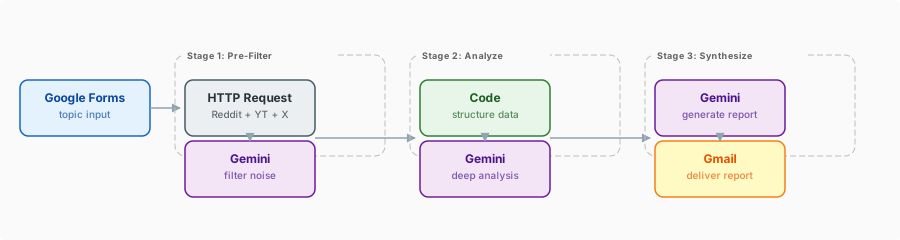
Form Input -- A user submits a research request through a form trigger specifying the topic, target audience, geographic focus, and analysis depth. This structured input ensures the AI pipeline operates with clear parameters.
Parallel Data Collection -- Three collection branches fire simultaneously. Reddit Search pulls relevant subreddit threads and comments. HTTP Request nodes query YouTube for related videos, view counts, and comment sentiment. X/Twitter Search captures trending conversations and engagement metrics. Apify and ScrapingBee handle supplementary scraping where platform APIs are limited.
Data Merge -- The Merge node combines data from all three platforms into a unified dataset. Code nodes normalize the data formats -- each platform returns data differently -- into a consistent schema with source attribution.
Stage 1: Pre-Filter -- A Gemini LLM Chain rapidly evaluates each content item for relevance to the research topic. Items below the relevance threshold are discarded. This stage operates as a cost optimization gate, preventing irrelevant content from consuming expensive deep-analysis tokens in the next stage.
Stage 2: Deep Analysis -- Qualified content enters a loop where the Gemini AI Agent performs detailed analysis on each item: sentiment classification, engagement pattern recognition, topic clustering, audience demographic inference, and virality potential scoring. Structured Output Parsers enforce consistent analytical output.
Stage 3: Synthesis -- A final Gemini LLM Chain receives all individual analyses and produces a cross-platform synthesis. It identifies patterns that span platforms, highlights contradictions between platform audiences, and generates specific content strategy recommendations with supporting evidence.
Multi-Channel Output -- The synthesized report is distributed through three channels simultaneously. Gmail receives the executive summary with key findings. Feishu receives the full report for team discussion. Google Sheets receives the raw data, individual analyses, and the synthesis -- creating a persistent analytical archive.
Three social platforms analyzed simultaneously. Most content analysis tools focus on a single platform. This workflow collects and cross-references data from Reddit, YouTube, and X, surfacing patterns that are invisible when platforms are analyzed in isolation.
Google Gemini as sole AI model. The entire 3-stage AI pipeline runs on Gemini, leveraging its large context window for the synthesis stage where it needs to process all individual analyses simultaneously. A single-model architecture simplifies credential management and cost tracking.
Form-based user input. The Form Trigger turns this complex workflow into a simple interface: type your topic, set your parameters, submit. Non-technical team members can run sophisticated multi-platform analysis without understanding the underlying automation.
Multi-channel output. Different stakeholders consume intelligence differently. Executives get email summaries. Teams get collaborative documents in Feishu. Analysts get raw data in Sheets. One workflow serves all three audiences without manual reformatting.
Tip: Key Techniques
3-Stage AI Pipeline -- Pre-filter, deep analysis, then synthesis. This staged approach reduces costs (filtering noise before expensive analysis) and improves quality (synthesis from structured analyses, not raw data). Apply this pattern whenever you are processing large volumes of content through AI.
Parallel Platform Collection -- Fire all data collection requests simultaneously rather than sequentially. This reduces total execution time from the sum of all platform queries to the duration of the slowest single query.
Form Trigger for Non-Technical Access -- Wrapping complex workflows behind a Form Trigger democratizes access. Anyone on the team can run the analysis without understanding webhooks, API parameters, or workflow internals. This transforms a developer tool into a team tool.
The workflow.json file in this folder can be imported directly into your n8n instance via Settings > Import Workflow.
This build ships with its complete n8n workflow. Download the workflow JSON, then import it in n8n with Workflows, Import from file, and add your own credentials before the first run.
KEEP LEARNING
The Workflow Engineer connects individual n8n concepts to testing, deployment and running a complete workflow.
APPLY IT TO YOUR SYSTEM
Bring the process, the tools involved and an example of where the current workflow gets stuck.