KEEP LEARNING
Build the bigger picture.
The Workflow Engineer connects individual n8n concepts to testing, deployment and running a complete workflow.
Showcase > Research & Data
62-node n8n workflow using OpenAI, Google Translate, and SerpAPI for 5-stage Amazon product name translation and validation.
The Amazon Product Name Translator is a 62-node AI pipeline that turns English product names into market-ready translations for any target Amazon marketplace. It uses Google Translate as a tool inside an AI agent, validates each result against live Amazon search data from SerpAPI and Brave Search, and runs every translation through five quality stages before writing validated results back to Google Sheets.
| Nodes | Category | Complexity | Key Integrations |
|---|---|---|---|
| 62 | E-Commerce / Localization | Advanced | OpenAI, Google Translate, SerpAPI, Brave Search, Google Sheets |
45-60 minutes including API credential setup, Google Sheets template configuration, and target marketplace selection.
This workflow takes English product names and transforms them into market-ready translations for any target Amazon marketplace. But it does not stop at translation. It runs each output through a five-stage quality pipeline that catches nuance errors, cultural mismatches, and keyword misalignment that standard translation tools miss entirely.
The system uses Google Translate not as a standalone tool, but as an instrument inside an AI agent's toolkit. The agent decides when and how to use machine translation, cross-referencing results against live Amazon search data from SerpAPI and web research from Brave Search. This means every translation is validated against what real customers in the target market are actually searching for.
Batch processing handles bulk product catalogs efficiently, looping through hundreds of product names while maintaining consistent quality. The final evaluation stage runs a comprehensive check against the original intent, marketplace conventions, and SEO best practices -- then writes clean, validated results back to Google Sheets.
Triggers
AI & Language Processing
Research & Validation
Data & Logic
Trigger -- The workflow starts on a manual trigger or a scheduled run. Product names and target languages are pulled from a Google Sheets input sheet.
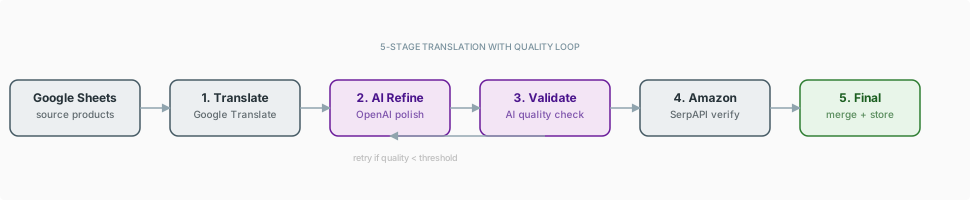
Initial Translation -- Each product name is sent to an AI Agent equipped with Google Translate as a tool. The agent generates an initial translation, leveraging both machine translation and its own language understanding.
Market Validation -- The translated product name is searched on Amazon via SerpAPI. Brave Search cross-references the translation against real marketplace listings to verify that the phrasing aligns with actual buyer search behavior.
AI Refinement -- A second AI Agent reviews the translation alongside the validation data. It adjusts wording for keyword density, cultural fit, and Amazon character limits, producing an improved version.
Batch Loop -- The loop nodes iterate through the entire product catalog, processing each item through the translation-validation-refinement cycle while managing API rate limits.
Final Evaluation -- A comprehensive OpenAI evaluation compares the final translation against the original English name, the marketplace data, and a set of quality criteria. Only translations that pass this gate are written to the output sheet.
Output -- Clean, validated translations are written to Google Sheets with metadata including confidence scores and any flagged concerns for human review.
Five-layer translation quality assurance. Most translation workflows run a single pass through an LLM and call it done. This system runs five distinct stages -- initial translation, marketplace validation, AI refinement, batch consistency checks, and final evaluation. Each layer catches errors that the previous one missed.
Amazon search validation. Instead of trusting that a translation "sounds right," the workflow searches the target Amazon marketplace to confirm that the translated product name matches what real buyers are searching for. This is the difference between a grammatically correct translation and one that actually drives sales.
Google Translate as an AI agent tool. Rather than using Google Translate as a standalone step, this workflow gives the AI agent direct access to Google Translate as a callable tool. The agent decides when to use machine translation, when to override it, and when to blend approaches -- producing results that outperform either tool in isolation.
Google Translate as Agent Tool -- Giving an AI agent access to Google Translate as a callable tool rather than a fixed pipeline step. This lets the agent make intelligent decisions about when machine translation helps and when it needs to deviate.
Marketplace Validation Loop -- Using SerpAPI to search the target Amazon marketplace and validate that translations align with actual buyer search terms. This closes the gap between linguistic accuracy and commercial relevance.
Multi-Stage Quality Gates -- Each translation passes through five independent evaluation stages. This redundancy ensures that even subtle errors -- cultural mismatches, keyword misalignment, character limit violations -- are caught before they reach a live listing.
The workflow.json file in this folder can be imported directly into your n8n instance via Settings > Import Workflow.
This build ships with its complete n8n workflow. Download the workflow JSON, then import it in n8n with Workflows, Import from file, and add your own credentials before the first run.
KEEP LEARNING
The Workflow Engineer connects individual n8n concepts to testing, deployment and running a complete workflow.
APPLY IT TO YOUR SYSTEM
Bring the process, the tools involved and an example of where the current workflow gets stuck.