KEEP LEARNING
Build the bigger picture.
The Workflow Engineer connects individual n8n concepts to testing, deployment and running a complete workflow.
Showcase > Customer Service
21-node n8n workflow using Mistral, Anthropic, Jina AI, Redis, and Google Sheets for automated Udemy student message triage and response.
The AI-Powered Student Support Agent is a 21-node n8n workflow that automatically triages and replies to Udemy student messages. It polls the Udemy Instructor API for unreplied threads, routes each through a multi-model AI agent with live web research, then either posts an auto-response or emails the instructor to escalate. Every interaction is logged to Google Sheets for a full audit trail.
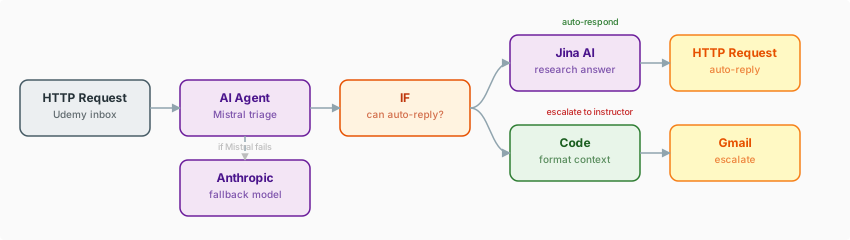
A 21-node multi-model AI agent that automatically triages and responds to Udemy student messages, escalating complex cases to the instructor with full audit trail. This workflow polls the Udemy Instructor API for unreplied messages, routes each through a structured AI agent with live web research capability, and either posts an auto-response or sends an email notification to the instructor. Every interaction is logged to Google Sheets for review and accountability.
| Nodes | Category | Complexity | Key Integrations |
|---|---|---|---|
| 21 | Customer Service / AI | Advanced | Mistral, Anthropic, OpenAI, Jina AI, Redis, Google Sheets, Gmail, Udemy API |
45-60 minutes including API credential setup, Redis configuration, and escalation rule customization.
The workflow monitors a Udemy instructor account for unreplied student messages on a recurring schedule. It fetches all pending message threads via the Udemy Instructor API, retrieves the full conversation history for each thread, and logs every message to a Google Sheets tracking sheet for audit purposes.
Each message is then passed to an AI Agent powered by a dual-model architecture: Mistral Large as the primary language model with Anthropic Claude as the fallback. The agent has access to Jina AI as a research tool for answering technical questions with current, verified information. A Structured Output Parser enforces a strict response schema, ensuring the AI produces a structured decision: respond automatically or escalate to the instructor, along with a confidence level and the response itself.
Based on the escalation decision, the workflow splits into two paths. For messages the AI handles confidently, the response is posted directly back to Udemy via the API. For messages requiring human judgment -- sales opportunities, personal questions, coaching requests, complaints -- the workflow updates the tracking sheet and sends an email notification to the instructor with a direct link to the message thread.
Triggers
AI & Processing
Data & Integration
Trigger -- The workflow runs on a recurring schedule (configurable interval) or via manual trigger. Both paths lead to a Global Constants node that loads instructor-specific configuration.
Fetch Unreplied Threads -- An HTTP Request node calls the Udemy Instructor API to retrieve all message threads with status=unreplied. The Split Out node unpacks the results array into individual items, and the Loop Over Items node processes them one at a time.
Retrieve Thread History -- For each unreplied thread, a second HTTP Request node fetches the full message history. This provides the AI agent with conversation context, not just the latest message.
Log to Google Sheets -- The message details -- sender, date, content, and aggregated previous interactions -- are appended to a tracking sheet. This creates an audit trail before AI processing begins. Every message is logged regardless of whether the AI responds or escalates.
Generate Session Key -- A Code node generates a random 48-character session key for Redis Chat Memory. This ensures each message thread gets an isolated memory context, preventing cross-contamination between unrelated conversations.
AI Agent Processing -- The AI Agent receives the latest message and conversation context. It runs on a dual-model architecture: Mistral Large as the primary language model with Anthropic Claude as the fallback. The agent's system prompt defines detailed escalation rules (sales opportunities, personal questions, coaching requests, complaints, payment issues) and auto-response guidelines (technical questions, greetings, how-to questions). When the agent needs current technical information, it uses the Jina AI research tool to search the web.
Structured Output Enforcement -- The Structured Output Parser (powered by OpenAI GPT-4.1 Mini) validates the agent's response against a strict JSON schema. The output includes: escalate_to_instructor (boolean), escalation_reason (enum), response (string), confidence (high/medium/low), and tools_used (array). Malformed output is caught before it reaches the routing logic.
Escalation Routing -- The IF node checks the escalate_to_instructor flag. True routes to the escalation path; false routes to the auto-response path.
Escalation Path (True) -- The tracking sheet row is updated with an "escalated" status, and a Gmail notification is sent to the instructor containing the student's message and a direct link to the Udemy message thread.
Auto-Response Path (False) -- The tracking sheet row is updated with the AI's response, confidence level, and a "responded" status. A third HTTP Request node then posts the AI-generated response directly back to the Udemy message thread via the Instructor API.
Multi-model architecture with structured output. Three different language models serve distinct roles: Mistral Large handles the creative work of understanding context and drafting responses, Anthropic Claude provides a fallback for reliability, and OpenAI GPT-4.1 Mini powers the Structured Output Parser that enforces the decision schema. This separation of concerns means each model is used where it excels.
Intelligent escalation logic. The system prompt encodes detailed escalation rules that go beyond simple keyword matching. Sales opportunities are flagged with highest priority because they represent revenue. Personal questions, coaching requests, and complaints are escalated because they require human empathy. Vague conversation openers are handled by the AI with a friendly prompt for more details, not needlessly escalated as ambiguous.
Full audit trail. Every message is logged to Google Sheets before AI processing begins. The sheet tracks message ID, sender, date, content, previous interactions, AI response, confidence level, and escalation status. This creates a complete record for review and refinement.
Live research capability. Jina AI gives the agent access to current web information for technical questions. Instead of relying on the LLM's training data, the agent can verify technical details, look up documentation, and provide accurate answers backed by real sources.
Tip: Key Techniques
Dual-Model Architecture -- Use different models for different roles. A capable model (Mistral Large) handles the nuanced work of understanding context and generating responses. A fast, cost-effective model (GPT-4.1 Mini) powers the Structured Output Parser where the task is formatting, not reasoning. A fallback model (Anthropic Claude) provides resilience if the primary model fails.
Structured Output as Routing Signal -- The Structured Output Parser does not just format the response -- it produces the routing decision. The escalate_to_instructor boolean directly drives the IF node. This means your routing logic is embedded in the AI's decision-making rather than hard-coded in n8n conditional rules.
Log Before Processing -- Always write incoming data to your tracking sheet before passing it to the AI agent. If the agent fails, the data is not lost. This is especially important for customer-facing workflows where losing a message means losing trust.
The workflow.json file in this folder can be imported directly into your n8n instance via Settings > Import Workflow.
This build ships with its complete n8n workflow. Download the workflow JSON, then import it in n8n with Workflows, Import from file, and add your own credentials before the first run.
KEEP LEARNING
The Workflow Engineer connects individual n8n concepts to testing, deployment and running a complete workflow.
APPLY IT TO YOUR SYSTEM
Bring the process, the tools involved and an example of where the current workflow gets stuck.