Human-in-the-Loop AI: Where to Put the Review Points
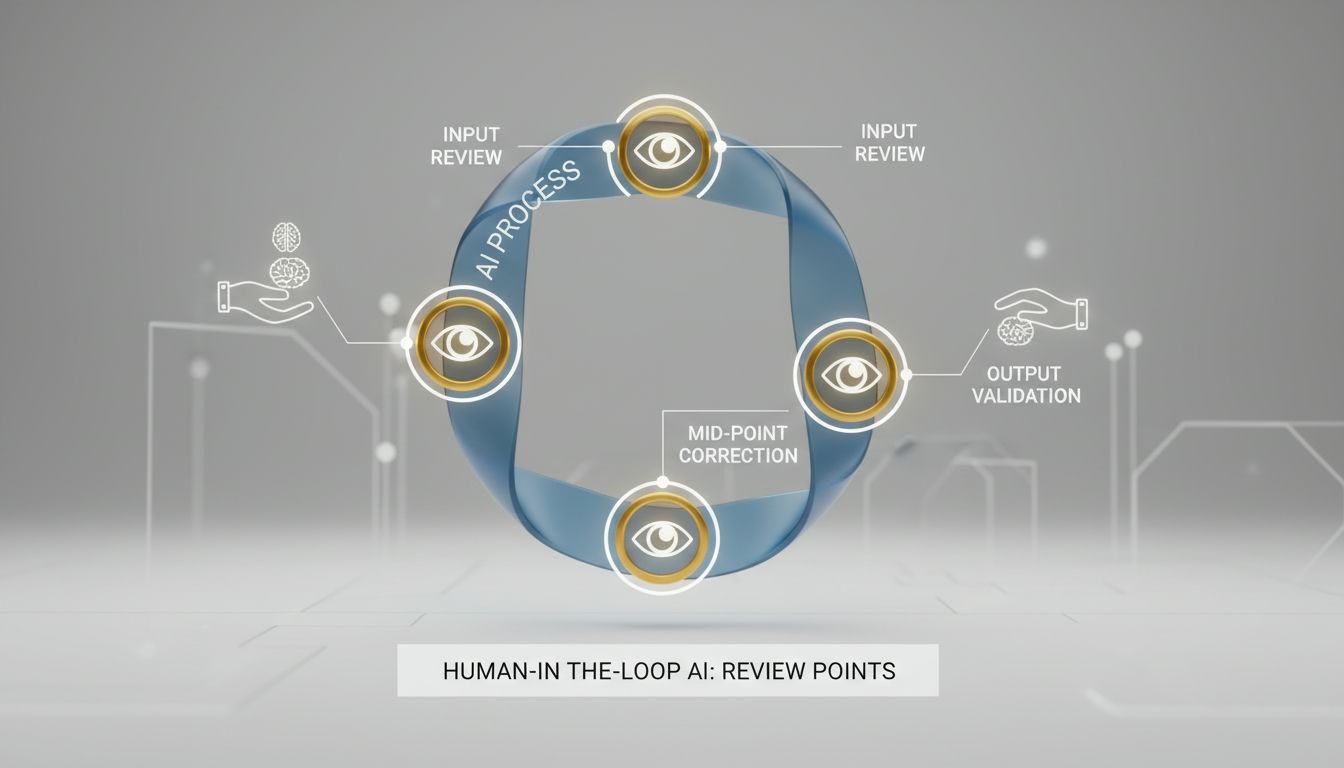
What Human-in-the-Loop AI Actually Means
Human-in-the-loop (HITL) AI is a system design where humans retain a defined checkpoint of review, approval, or correction inside an otherwise automated AI workflow. AI does the heavy lifting, drafting, classifying, and extracting, but the process cannot finish without a person explicitly signing off, correcting, or intervening at that checkpoint. In large language models, the same idea shows up during training as reinforcement learning from human feedback, but for business teams HITL matters less as a training technique and more as a workflow design choice about who keeps control and where.
That checkpoint is what separates HITL from its neighbors. In full automation, there is no human stop, the system runs to completion on its own. In manual work with AI assistance, the human does everything and AI only suggests text or labels.
The term started in model training. IBM frames HITL as a system where a human actively participates in the operation, supervision or decision-making of an automated system to ensure accuracy and safety. Google Cloud describes reinforcement learning from human feedback as a method through which foundation models can be aligned to complex human values.
The textbook definition is only the starting point. The real question for anyone building a workflow is where that human checkpoint actually sits.
Three Places a Review Point Can Go in a Workflow
Elementum routes purchase orders above $25,000 to VP approval while letting orders below that execute automatically when confidence exceeds 92%, an example that illustrates the three places a human review point can go in a workflow: before the AI acts, while it runs, and after it finishes.
Defining HITL is easy; the harder design question is deciding which of these three placements a given task actually needs.
1. Pre-execution approval
The workflow pauses before any irreversible action. The AI prepares a draft, classification, or recommendation, then a Wait node holds execution until a human approves in Slack, Telegram, or email. The human decision sits inside the path, so nothing executes until authorization is logged.
Suits high-stakes work like publishing, customer communications, supplier commitments, and payments where reversal cost is high. It gives you traceable authorization but adds the most latency. Throughput is capped by reviewer availability, so queues grow if review capacity does not.
2. In-line confidence-threshold escalation
The AI runs autonomously, but routing logic decides mid-pipeline whether to continue or pull a human in. Implementation in workflow tools is typically an IF branch on explicit signals: confidence scores, dollar amounts, data sensitivity flags, or regulatory category. One common pattern is invoices matched below 85% pausing for AP review while higher-confidence matches auto-approve, and exception flags routing any sanctioned-country supplier to a person regardless of score.
Suits mixed-volume pipelines where most cases are routine but edge cases need judgment: document extraction, ticket triage, lead enrichment. Latency is variable and only the low-confidence slice pays the human delay, which keeps bulk throughput fast without flooding reviewers.
3. Post-hoc audit
The AI completes the task and humans review after the fact via sample or exception dashboard. The reviewer supervises parallel to execution and retains authority to stop, override, or roll back, but does not block each run.
Suits high-volume, low-risk actions with clear policy boundaries where rollback is cheap. It is the fastest option because the ceiling is system capacity rather than reviewer capacity, but it catches drift only after execution, so audit trails and override paths are required.
Effective Oversight vs. Rubber-Stamp Review
Effective oversight in human-in-the-loop AI means the AI has a narrow, verifiable job, the reviewer has real authority to stop or reroute the pipeline, and every decision is traceable back to its source evidence, not just a sign-off in a log.
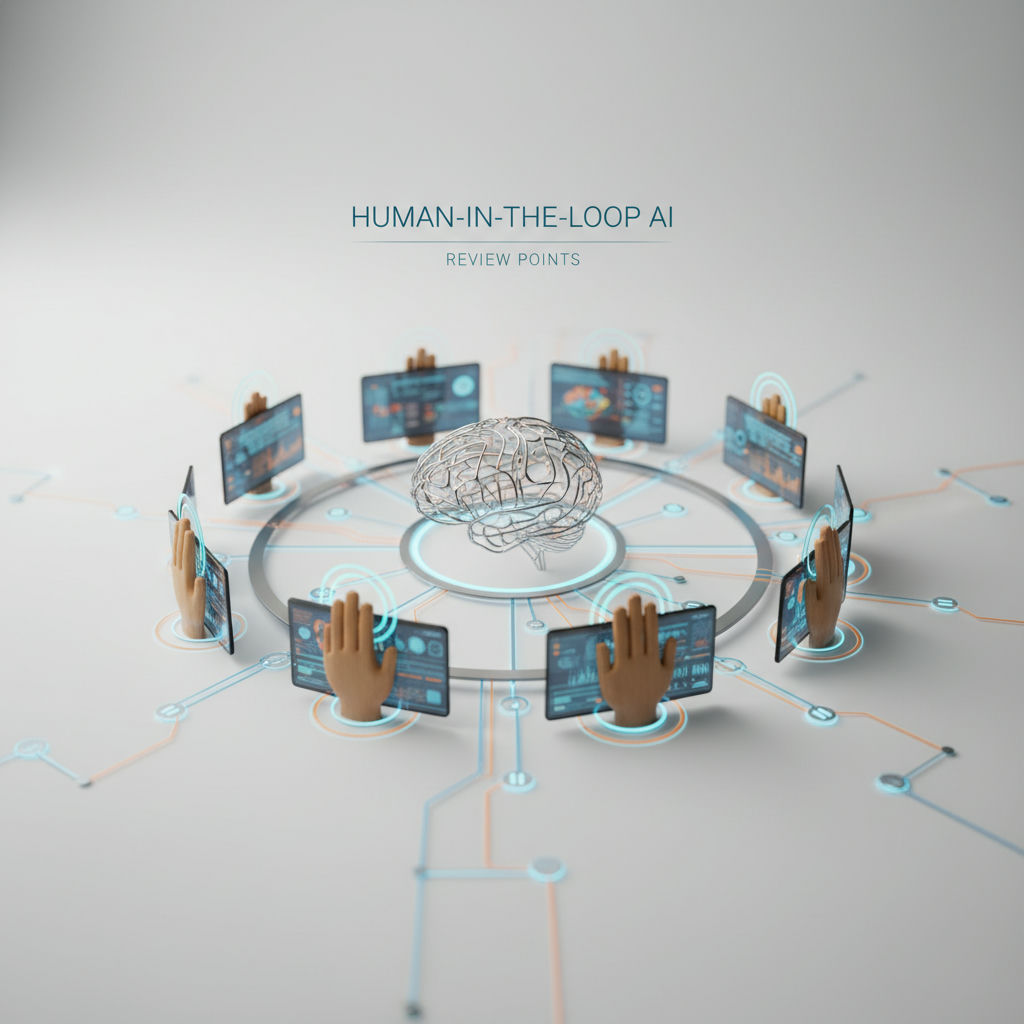
Knowing where a checkpoint goes doesn't guarantee it works. Plenty of HITL systems have a human in the loop who can't actually change the outcome. The difference shows up in four design choices.
1. A well-defined task boundary for the AI. "Review this document" is not checkable. "Extract invoice total, currency, and due date, with confidence per field" is. When the AI's job is scoped like that, the human knows exactly what to verify. Keep people in control by giving AI a well-defined job.
2. Real authority to stop the flow. IBM frames this well as designing AI systems so that people retain meaningful oversight and decision-making authority, not just a rubber stamp at the end. If a reviewer can only acknowledge that they saw an output, the pipeline will continue regardless. Effective review lets them reject, correct, reroute to a second approver, or pause publishing.
3. An audit trail that shows reasoning, not just action. Log who reviewed, when, old and new values, why it was flagged, and the source location. In document processing, that means showing the flagged value next to its highlighted region on the page so the check is against evidence, not memory.
4. Sensible escalation triggers. Triggers that are too loose flag everything and create fatigue; too tight and nothing gets flagged. Teams that get this right set thresholds per field, not per document, stricter on fields that move money or publish externally, looser on fields that are easy to fix later. Any field below the threshold you set goes to a reviewer queue ordered by risk and age, with corrections feeding back into accuracy.
A worked example: a research pipeline extracts claims and preserves the exact source paragraph and URL for each. Before a brief publishes, a human verifies the citation supports the claim and can reject the paragraph back to research. Or, in accounts payable, extracted totals that fail a business rule (line items don't sum) or fall below confidence go to a human who sees source and score side-by-side.
This is how systems built around review actually hold up. In client work, Hesham Mashhour builds this as AI agents with defined tasks and limits, plus exception handling that surfaces edge cases for human review, with approval workflows wired into the team's existing tools so the checkpoint is where work already happens.
A review point only works if the human reviewing it has the authority and the information to actually stop the process. Otherwise it's a rubber stamp, not oversight.
Oversight has a cost, though, and that cost is the real deciding factor in how much of it to build in.
Choosing the Right Amount of Human Review for the Task
Choosing the right amount of human review for an AI task fails when teams default to heavy approval for everything, assuming more oversight is always safer. Once you know what good oversight looks like, the practical work is deciding how much of it any given task actually deserves, based on reversibility, stakes, volume, ambiguity, and compliance exposure.
Every review point adds latency, queue time, and context-switching cost for the reviewer. Give AI a well-defined job and you can keep the human checkpoint where it prevents real harm, instead of turning high-volume, low-risk work into a bottleneck that erases the value of automation.
| Task characteristic | Light-touch review (post-hoc audit) | Heavy review (pre-execution approval or in-line escalation) |
|---|---|---|
| Reversibility of the AI's output | Easily undone — audit a sample on schedule | Hard to undo — sign-off before release |
| Stakes / impact of an error | Low impact — fixable on next pass | High impact — changes valuation or trust |
| Volume / frequency of the task | High volume, repetitive — spot-check a sample | Low volume, high variance — review each instance |
| Ambiguity of the input data | Structured, clean input — consistent schema | Unstructured, variable input — edge cases common |
| Regulatory or compliance exposure | No regulatory footprint — internal notes | Regulated output — approval logs, people in control |
The pattern is consistent: when an output is hard to reverse, carries external impact, comes from messy input, or creates compliance exposure, lean toward pre-execution approval or confidence-based escalation. When the work is reversible, internal, and high volume, post-hoc audit keeps you fast without losing control.
For example, financial data extraction for an investor update triggers heavy review because an error propagates and is hard to recall, routine content tagging for internal search fits light-touch spot-checks, and customer-facing responses sit in the middle: automate the draft, escalate when tone, claims, or policy flags are present.
If you are weighing how to operationalize this, the build decision matters as much as the policy. A workflow where review points are first-class steps, not afterthoughts, is easier to maintain than bolting approvals onto a black-box tool. See the build vs. buy checklist for custom agents for how that choice affects escalation and audit logging.
Common Mistakes That Undermine Human-in-the-Loop Systems
Human-in-the-loop systems fail most often not from bad model output, but from review fatigue, unclear ownership, missing audit trails, and miscalibrated escalation thresholds that turn oversight into theater.
Even a well-placed, well-justified review point can fail if the surrounding process isn't built carefully. These are the failure patterns worth watching for.
1. Review fatigue becomes rubber-stamping. When every low-value edge case escalates, reviewers learn to approve to clear the queue. The queue looks green, but nothing is actually being checked. The fix is to tighten escalation criteria so only true exceptions reach a person, sample low-risk outputs instead of reviewing all of them, and rotate responsibility so the same person isn't stuck approving identical items all day. Track approval rate and time-to-decision as health metrics: an approval rate climbing toward 100% with shrinking review time is the decay signal.
2. Unclear ownership. If no one is explicitly accountable for the override, decisions get deferred or made by whoever happens to be online. Every review point needs a named owner and an SLA. In workflow tools this is concrete: in n8n you configure a human approval step that pauses the workflow and routes the request to a specific channel such as n8n Chat, Slack, or Telegram until someone chooses Approve or Deny. If that route has no owner, the workflow just waits.
3. Missing audit trails. Without a log of what the AI proposed versus what the human decided and why, you cannot improve the system or prove compliance. Log the original AI output, the tool parameters it wanted to use, the human decision, and a short reason code together. Keep evidence linked, not in screenshots.
4. Poorly calibrated confidence thresholds. Set them too low and you flood reviewers; set them too high and bad outputs pass silently. Start conservative, measure how many escalations are actually actionable, then adjust the threshold and the prompt or retrieval logic that feeds it. A good review point includes a way to mark "this should not have escalated" so you can retune without guessing.
Building HITL Into a Workflow You Already Run
List every hand-off, decision, and publish step in the process you already run, exactly as the team does it now, then add a human checkpoint only where judgment, compliance, or reputational risk cannot be delegated. If your research pipeline already pulls sources, drafts summaries, and publishes to a CMS, the work is deciding which of those steps is routine and which needs a person to say yes, no, or fix it.
AI-powered content systems and workflow automation built around your team’s tools, processes, and goals—designed, implemented, and maintained by a Cambridge-trained automation engineer.
Map the manual process first, on a whiteboard or in your workflow tool, and label each step as routine or high-stakes. Routine means an error is cheap and reversible. High-stakes means an error changes what a client sees, breaks compliance, or costs trust.
Design the review point around the task, not the tool. Give AI a well-defined job with clear boundaries: what it is allowed to decide, what data it must cite, and what it must leave untouched. Build the escalation trigger before you build the automation itself: the condition that routes an item to a person, the information the reviewer sees, and the log that records the decision. Keep people in control by giving the reviewer real stop-the-line authority, not a passive thumbs-up button.
Human-in-the-loop is not a temporary patch for immature models. For any workflow where judgment, evidence, or approval matters, it is a permanent architectural choice. Skip that design work and automation does not save time; it just moves risk downstream to the point where it is more expensive to catch.
If you are mapping your own process, the next step is to sketch those review points with someone who builds them into a fixed-price automation from the start, so the system reflects how your team actually works.
Sources
- What Is Human In The Loop (HITL)? | IBM
- RLHF on Google Cloud
- Human-in-the-Loop vs. Human-on-the-Loop: When to Use Each for Enterprise Workflows
- Human in the loop automation: Build AI workflows that keep humans in control
- Why “human in the loop” alone is not a governance strategy
- Human-in-the-loop systems: how to design review that holds up in production
- Human-in-the-loop for tools | Build | n8n Docs
Frequently Asked Questions
What dollar amount should trigger a human approval step?
Use reversal cost and risk as guide, not a universal number. The Elementum example routes orders above $25,000 to VP approval and auto-executes below that when confidence exceeds 92%, with routing logic also considering data sensitivity and regulatory category.
How do I choose a confidence percentage for auto-approval versus escalation?
Start per field, not per document, stricter on fields that move money. Many teams auto-approve invoice matches only above 85% and pause lower scores for AP review, while purchase order creation may require 92% to run without a person, then tune based on actionable escalations.
What happens if no one approves a paused workflow?
In tools like n8n, the workflow pauses and waits for Approve or Deny until someone acts, so throughput is limited by reviewer capacity. Prevent stalls by assigning a named owner, an SLA, and delivering the request in n8n Chat, Slack, or Telegram.
Can I use all three review placements in one pipeline?
Yes. A common design auto-executes routine items, uses an IF branch mid-pipeline to escalate low-confidence or sensitive cases when confidence is low or an action fails, and logs everything for post-hoc audit. That keeps bulk speed high while reserving the Wait node for true exceptions via human approval.
How is human-in-the-loop in training different from human-in-the-loop in production?
IBM defines production HITL as a system where a human actively participates in operation, supervision or decision-making, while Google Cloud describes RLHF in training as a method to align foundation models to complex human values. One shapes the model, the other shapes the workflow that uses the model.
How do I keep review from becoming a rubber stamp?
Meaningful oversight means people retain decision-making authority, not just a rubber stamp at the end, with real power to reject, correct, or reroute. Track approval rate and time-to-decision as health metrics, tighten criteria that flag everything, and rotate reviewers so fatigue does not set in.
What should a good HITL audit trail capture?
Log who reviewed, when, the original AI output, new values, why it was flagged, and the source location highlighted next to the field. Any field below the threshold you set goes to a reviewer, and that correction history should feed back to improve the model per Docsumo's pattern.
Should I set one threshold for the whole document or per field?
Set thresholds per field, not per document, stricter on fields that move money, looser on fields that are easy to fix later. That way an invoice total below confidence pauses for review while a low-risk description can auto-approve.