INTERACTIVE WORKBOOK
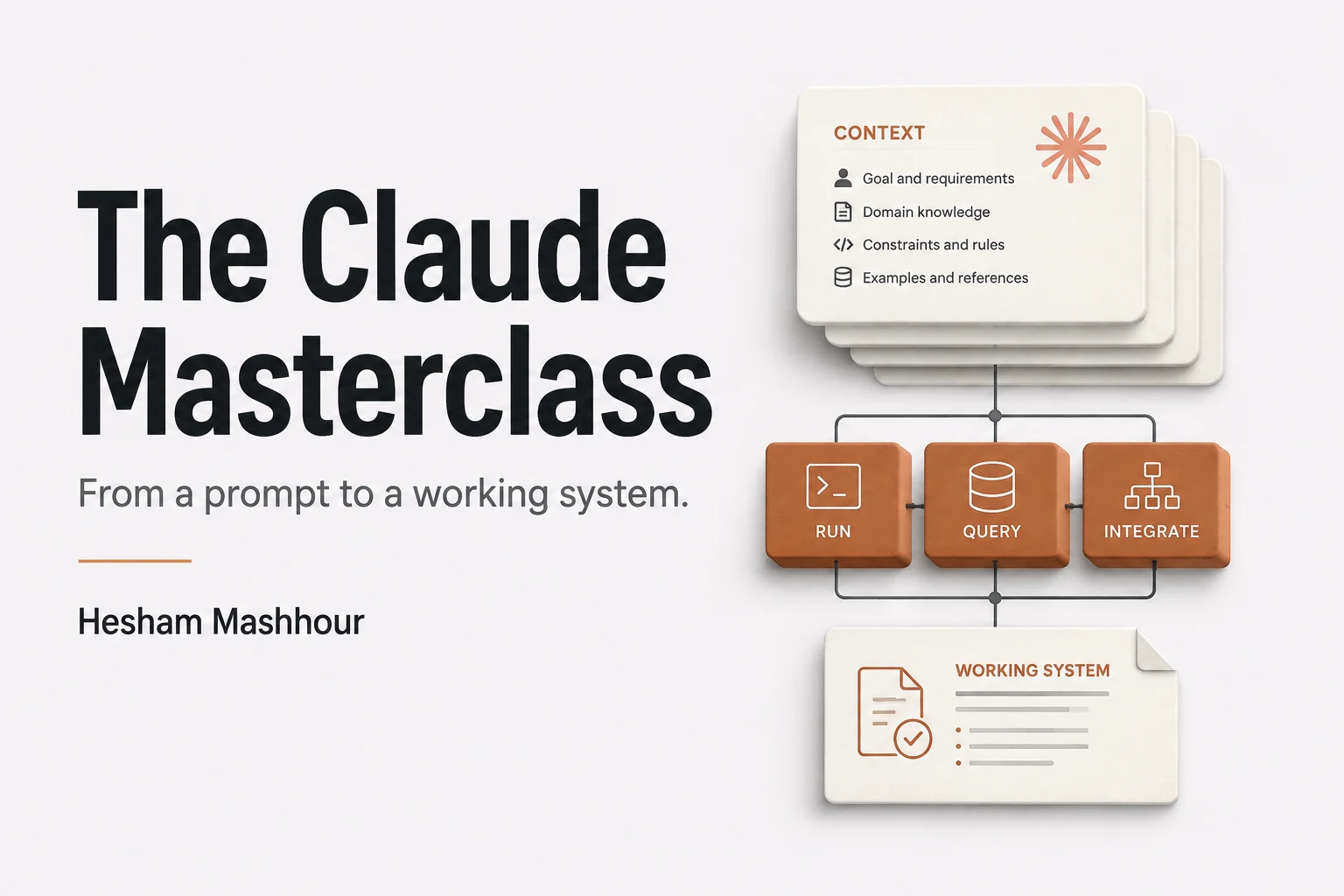
The Claude Masterclass
From First Prompt to Production Agent
Get the PDF
22
chapters
6
parts
4.2h
reading
01
Understanding Claude
Part 01 · 3 chapters
01
What Claude Actually Is (and What It Isn't)
Most people treat Claude like a search engine with manners. That misunderstanding costs them 90% of its value before they type a single prompt.
12 min
02
Constitutional AI: The Guardrails That Matter
Most users think Claude's safety system is a content filter that blocks bad words. It's actually a multi-layered reasoning architecture that shapes every response you receive — and understanding it makes you a dramatically better prompter.
11 min
03
Artifacts and Extended Thinking
Claude's most powerful features are the ones most users never touch — because they never move past the single-question, single-answer pattern that wastes the model's deepest capabilities.
10 min
02
The Prompt Engineer's Toolkit
Part 02 · 4 chapters
04
Anatomy of a Prompt That Works
Most people write prompts the way they write emails — stream of consciousness, hope for the best. That's why most people get mediocre outputs.
12 min
05
Zero-Shot, Few-Shot, and Chain-of-Thought
Three prompting strategies that separate people who get generic answers from people who get exactly what they need — and when to use each one.
11 min
06
Roles, Context, and the Art of Constraint
Three levers that transform Claude from a general-purpose assistant into a specialist who writes like your best colleague in the room.
12 min
07
Integrations and Deployment
Claude stops being a chatbot and starts being infrastructure when you connect it to the systems where your actual work lives.
10 min
03
The API Layer
Part 03 · 4 chapters
08
Your First API Call
The first API call most developers make is wrong — not because the code is broken, but because they treat the API like a search engine instead of a reasoning partner.
12 min
09
Multi-Turn Conversations
The API doesn't remember you. Every request is a blank slate — and that's not a limitation, it's the most important architectural decision you'll make.
11 min
10
Structured Responses and JSON Mode
Free-text responses are fine for chat. The moment you need to feed Claude's output into another system, you need structure — and hoping the model formats things correctly is not a strategy.
11 min
11
Streaming and Real-Time Output
The standard API call makes your users stare at a blank screen while Claude thinks. Streaming makes them watch Claude think — and that changes everything about perceived performance.
10 min
04
Production Engineering
Part 04 · 4 chapters
12
Building Context-Aware Applications
Most API calls fail not because the code is wrong, but because Claude has no idea who it is talking to or why.
12 min
13
Task-Based Mini-Agents
The most reliable AI systems I have built are not monolithic agents that try to do everything -- they are small, single-purpose workers that each do one thing well.
12 min
14
Reliability and Error Handling
Everything works in the happy path. The question is what happens when Claude returns garbage at 2 AM on a Saturday.
11 min
15
The Cost-Performance Tradeoff
Two API calls can produce the same answer, but one costs ten times more and takes five times longer. The difference is engineering, not magic.
11 min
05
RAG — Giving Claude a Memory
Part 05 · 3 chapters
16
What RAG Is and When You Need It
Everyone says they're doing RAG. Almost nobody is doing it well — because they skipped the part where you decide whether you need it at all.
12 min
17
Chunking, Embeddings, and the Ranking Pipeline
Your retrieval system is only as good as how you split your documents, how you represent them numerically, and how ruthlessly you filter the results.
12 min
18
Building a Production RAG System
The gap between a working demo and a system your users trust is not a feature list — it is a set of engineering decisions about retrieval architecture, context assembly, and failure modes.
13 min
06
MCP and the Agent Frontier
Part 06 · 4 chapters
19
The Model Context Protocol
Every AI integration you've built is a one-off. MCP is the reason your next hundred won't be.
12 min
20
Tools, Resources, and Real-World Integrations
An MCP server with one toy function proves the protocol works. An MCP server that reads files, queries databases, and calls live APIs proves it's worth adopting.
11 min
21
Multi-Agent Collaboration
A single agent can reason. Multiple agents can specialize, delegate, and finish faster — if you know when to split the work.
12 min
22
End-to-End Workflow Automation
The pieces exist — MCP, RAG, agents, tools. The question is how to wire them into a pipeline that runs without you watching.
12 min
Impossible Workflows
Automation Blog
Automation University
Impossible Workflows
Automation University
Content Expertise
Contact HESH