Prompt governance defines how content teams write, test, approve, version, deploy, and retire prompts to maintain consistency at scale. This playbook details a seven-stage lifecycle, debunks common myths, walks through a transcript-to-newsletter prompt chain with version tags and test fixtures, explains drift detection and quality thresholds, and shows small teams how to start minimal and add governance as volume and risk grow.
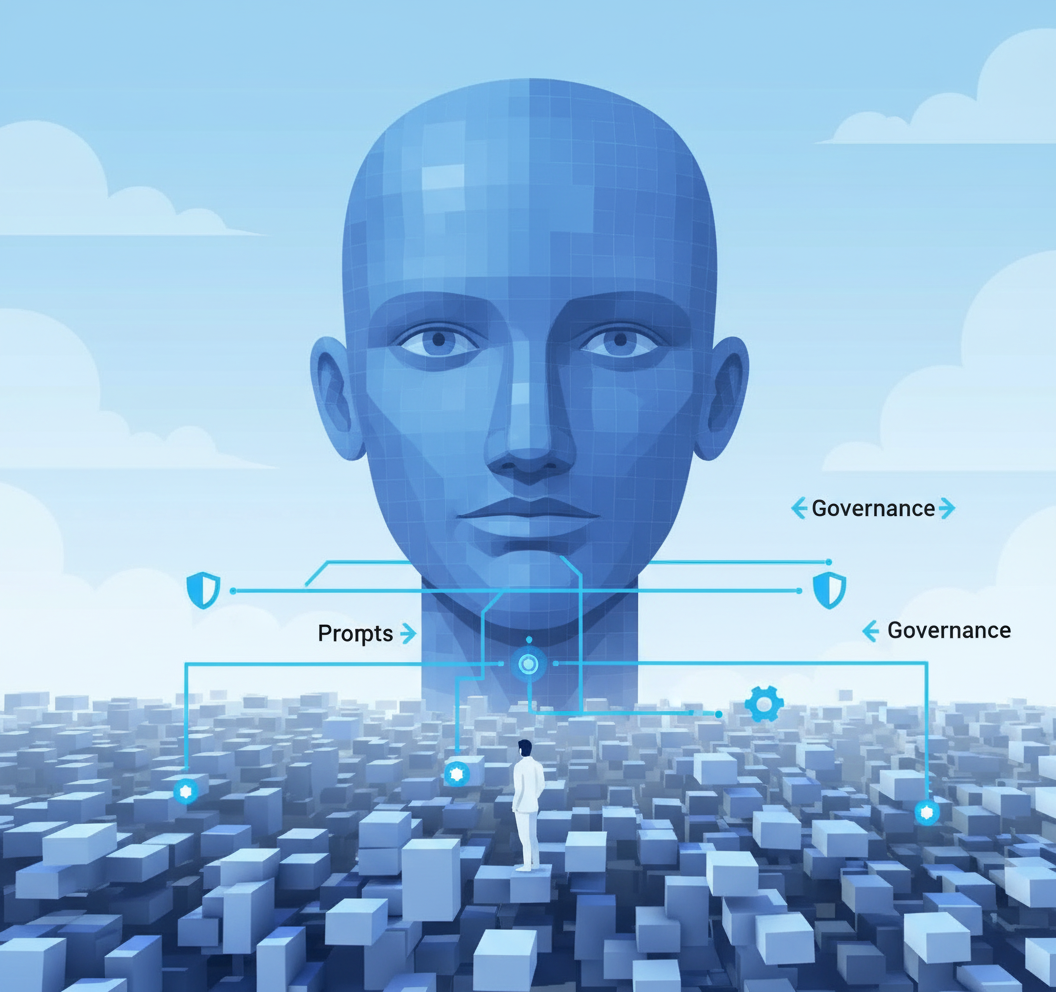
Prompt governance is how a content team controls how the prompts behind newsletters, briefs, social posts, and transcript summaries get written, tested, approved, versioned, and retired so output stays consistent and on-brand at scale. It is the operational discipline that decides which prompt version runs in production, who can change it, and what counts as good enough to publish.
That is different from how most search results define it today. Some current guides frame prompt governance as an enterprise control layer for compliance, built around RBAC, legal approval gates, and the kind of regulatory regimes regulated industries have to answer to. That framing is built for large organizations managing risk across hundreds of users.
For a lean media team, prompt governance is smaller and more practical. It is about preventing the slow drift where five versions of the same brief prompt live in five docs, no one knows which one the automation actually uses, and a model update quietly shifts voice. Once the definition is clear, the real question is what governance looks like day to day: what actually happens to a prompt from first draft to retirement.
Here's the lifecycle a prompt actually travels through once a team commits to governing it. Enterprise coverage like CIO.com describes lifecycle management where prompts are versioned, reviewed, refined and eventually retired as obsolescence becomes obvious. Changes are intentional, not accidental; the same principle applies for content teams, just with lighter tooling.
Most production prompt tools already enforce stages that lean teams can borrow. Promptitude's docs note that all other versions that aren't designated as Live or Preview fall into Draft, which mirrors how a writer should treat work-in-progress. The first stage is best understood as the step that transforms a rough prompt draft into a well-optimized, structured input that consistently generates high-quality AI responses.
The operational version for a content pipeline uses seven explicit gates:
| Lifecycle Stage | What Happens | Artifact Produced | Typical Owner |
|---|---|---|---|
| Draft | Write first version from intent and examples | Prompt library draft file with purpose, model, owner notes | Writer |
| Test | Run against 3-5 real inputs, capture failures | Test-output samples + pass/fail checklist | Writer |
| Approve | Second pair of eyes checks voice, accuracy, safety | Approval sign-off note with date and reviewer | Editor |
| Version | Freeze immutable copy with semantic tag | Versioned library entry vX.Y.Z + changelog line | Workflow owner |
| Deploy | Wire tagged prompt into production workflow | Deployment log entry linking prompt tag to workflow node | Workflow owner |
| Monitor | Collect live outputs and spot regressions | Production sample log and review notes | Workflow owner |
| Retire | Archive when replaced or obsolete | Archived status + link to successor prompt | Workflow owner |
In practice: Draft lives as a single file in your prompt library, Notion, or GitHub with purpose and model noted. Test produces a folder of sample outputs, for example, three transcript snippets run through to brief outputs. Approve is a short sign-off note: who approved, date, what changed. Version creates an immutable copy tagged v1.2.0 with a one-line changelog. Deploy logs where that tag is now live, so you can trace a newsletter issue back to prompt v2.1.0. Monitor keeps a short production sample set. Retire marks status to Archived and points to the successor.
That lifecycle only works if teams avoid a few widespread misunderstandings about what governance requires.
Most teams fail at governance not from lack of tooling but from misjudging how much process it actually requires.
Myth 1: Governance means legal review for every prompt. Enterprise coverage pushes a heavy gate where tiered approval framing calls for role-based access, policy-bound execution and human approval thresholds. That model fits regulated workloads, not your social caption. Risk-tier it: a social repurposing prompt gets a peer check, while a customer-facing brand-voice prompt that makes health, financial, or legal claims needs documented approval. Governance isn't "everything goes to legal," it's deciding which prompts don't.
Myth 2: A shared doc of good prompts is governance. A doc is a library. Governance is what you can prove about what's in it: which version shipped, what test set it passed, who approved it, and when it changed. Without version tags and a simple pass/fail test, you can't roll back the brief prompt that started hallucinating sources last Tuesday.
Myth 3: Governance slows teams down. Ungoverned prompts create more rework. When three editors run three slightly different newsletter drafts, voice slips, facts get dropped, and you rewrite the same piece twice. A light review tier and a single source of truth removes that churn.
Myth 4: Governance is a one-time setup. The Policy-as-Prompt model treats policies as executable guardrails that reduce injection risk and block out-of-scope requests, which only works if those guardrails stay current. Model providers ship silent updates, your voice evolves, examples age. If you never re-test, the prompt you approved last quarter is not the prompt you are running today.
Governance that blocks every prompt behind review isn't governance, it's a bottleneck. Risk-tier it or it won't survive contact with a real content calendar.
Take one weekly customer call that has to become a brief, a newsletter, and a LinkedIn post. You don't run one giant prompt. You run three narrow prompts chained together, a standard pattern for prompt chaining as a chain of subtasks where the output of one becomes the input to the next.
The chain:
This is a common shape for teams that need to turn a raw interview transcript into a case study, social snippets, and a newsletter blurb; governance is what keeps that repeatable instead of a one-off scramble.
Where governance lives in this chain:
/prompts/transcript-to-brief with ID transcript-to-brief-v2, plus the same tag in the n8n workflow node annotation and git commit. The partials have their own versions, e.g., voice-newsletter-v3.2026-05-01 | brief-to-newsletter v2 -> v3 | owner: content ops | change: removed exclamation rule | reason: brand voice update | regression: passed fixture 04.A single prompt chain is manageable by hand. The real test of governance is what happens when a team runs dozens of these at scale, month after month.
The transcript-to-newsletter example shows governance working on one chain. The harder problem is keeping it working across every chain, indefinitely.
End-to-end content pipelines engineered in n8n and real code—turning scattered inputs into published, high-quality content without the slop.
Model providers ship updates without asking you. Your prompt stays identical, yet tone, length, or factual adherence shifts. That's prompt drift, defined as gradual change in output behavior even when the prompt hasn't been modified. Left unchecked, a newsletter voice that once passed review starts publishing slightly off-brand summaries, or a brief extractor begins hallucinating bullet points.
Maintenance is how you catch that before publication. It has three parts:
This is the layer most content teams skip because it requires logging, sampling, and alerting most n8n or Zapier setups don't include by default. As one real example, Hesham.us Automated Content Pipelines builds drift detection and quality gating directly into the pipeline with 12-month aftercare, so failing outputs pause instead of publishing.
You can run ongoing governance with this lightweight audit template:
| Field / Step | What to enter | Example |
|---|---|---|
| Check Name | Which quality check | {newsletter_voice_check} |
| Cadence | How often audit runs | {every Monday} |
| Sample Set | Which outputs to sample | last {20} outputs from {newsletter_draft_prompt v1.3} |
| Quality Threshold | Pass/fail rule | LLM-as-judge {voice_match} >= {0.85} |
| Alert Action | What happens on fail | Slack to {owner} + pause {auto-publish} |
| Model Version Trigger | When to force re-approval | when {openai model id} changes from {gpt-4o-2024-05-13} |
| Owner | Who reviews | {content_ops_lead} |
| Log Location | Where results live | {Notion DB / Sheet: link} |
None of this matters unless a team can actually start applying it, so here's where to begin.
With the full model on the table, the practical question left is where a team with no governance today should actually begin.
Start with one artifact: a versioned library where every production prompt lives in the same format. Owner, purpose, last tested model, one input/output pair, and a version tag. Not a folder of docs. A single source of truth. If you are under five people and most prompts only feed internal drafts, this alone will carry you for months. You get traceability without adding meetings.
Add a gate only when risk goes up. That second layer is a lightweight approval for anything customer-facing or revenue-adjacent: final newsletter, client brief, public social queue. One reviewer, async comment, 24-hour SLA. Internal helpers stay on edit-and-ship. This keeps review load tied to consequence, which is how small teams avoid turning governance into overhead.
Defer the heavy machinery until you feel real pain: automated drift checks, publish-blocking quality gates, formal audit logs. Those pay off once you pass roughly 15-20 prompts in active production, publish daily across channels, or change models or orchestration tools. Before that, a weekly spot-check of live outputs beats a dashboard no one looks at.
Pick your starting point by two questions: how many prompts touch an outside reader, and how many people can edit them? High on either means move to step two now. Low on both means nail step one and stop.
Good governance starts minimal and risk-tiered, then grows only as prompt volume and stakes increase, not the other way around.
Roll back to the previous stable tag logged in your deployment log and pause auto-publish using the alert action from the audit template. Record the incident and successor link as part of retirement practice. Re-approval can happen async once the owner returns.
Pin the model ID in your prompt library and treat any change as a forced re-approval trigger. Pull a weekly sample of live outputs and grade against the original approval rubric. Prompt drift is defined as gradual change in output behavior even when the prompt itself hasn't been modified.
Yes. The example uses locked partials like voice-newsletter-v3 with its own version, composed of core role, brand voice, and safety wrappers. That lets you update tone once, test all dependent prompts, and keep traceability instead of editing inline.
For most content prompts, running against 3-5 real inputs with a pass/fail checklist is enough for the first go-live. Reserve larger fixtures for prompts that make factual, financial, or health claims or that are customer-facing. Keep samples and checklist next to the versioned entry.
Avoid it. Use prompt chaining where a task is split into subtasks, as shown with transcript-to-brief outputting JSON that feeds separate brief-to-newsletter and brief-to-social prompts. Reusing one prompt mixes length and voice rules and makes regression checks harder.
Keep a single source of truth with immutable semantic tags like vX.Y.Z and a one-line changelog noting owner, change, and reason. Treat all other versions that aren't designated as Live or Preview as Draft so edits do not overwrite production until explicitly versioned and approved.
Log the prompt ID and tag in the workflow node annotation and in a deployment log linking tag to workflow node. Store the canonical prompt in your library with owner, purpose, and model, and use the audit template's log location field so an issue traces back to a tag like v2.1.0.
Update with a new semantic version when purpose stays the same but wording improves. Retire and archive with a link to the successor when obsolescence becomes obvious or the whole chain is replaced. Prompts are versioned, reviewed, refined and eventually retired, not deleted.
End-to-end content pipelines engineered in n8n and real code—turning scattered inputs into published, high-quality content without the slop.
Learn moreCompany bio