
Content operations drift is a systems problem, not a writing problem. This technical guide walks through building a five-step detection and remediation pipeline: establishing a quantitative baseline, deploying layered detection methods (automated semantic analysis, statistical audits, and human review), building alerting workflows with measurable thresholds, integrating CI/CD-style quality gates into your CMS, and scaling for enterprise operations. Includes pseudocode, n8n workflow patterns, and specific threshold values you can deploy immediately.
Content operations drift isn't a writing problem, it's a systems problem. When a team publishes thousands of articles a month and nobody notices that tone has shifted from consultative to salesy, or that structural templates are degrading across multiple CMS instances, what's broken isn't the writers. It's the absence of engineered detection.
The four pillars of drift, Voice & Tone, Structure, Process, and Theme, each require different instrumentation. Voice drift might register as a KL Divergence score crossing 0.50. Structural drift surfaces when metadata staleness exceeds 15% of documented standards. Process drift is harder to quantify but shows up downstream: a drop of more than 5% in CTR or 3% in AI retrieval accuracy often traces back to decaying workflows.
How to Detect and Fix Content Operations Drift: 1. Baseline: Document voice, structure, process, and theme with measurable thresholds. 2. Monitor: Deploy AI tools, statistical audits, and human-in-the-loop reviews. 3. Flag: Set alert thresholds (e.g., PSI > 0.25 triggers review) and automate notifications. 4. Analyze: Investigate root causes using a standardized checklist. 5. Calibrate: Retrain models or update standards, then loop back to monitoring.
The rest of this guide walks through each step with implementation detail, code, thresholds, and integration patterns you can deploy.
Drift detection begins with a question most teams skip: What exactly are we measuring against? Without a quantified baseline, every drift alert becomes a subjective argument.
Document your brand voice along dimensions you can measure programmatically: formality (1, 5 scale), sentence complexity (Flesch-Kincaid band), sentiment polarity, and terminology compliance rates. The standard alerting framework uses Population Stability Index with three bands: scores below 0.10 are green (safe), 0.10 to 0.25 are yellow (warning), and above 0.25 is red, action required. You don't need perfect PSI calculations on day one; even a cosine similarity check against reference documents gives you a starting signal.
Structural drift is the easiest to instrument and the most commonly ignored. Capture expected document structure as a machine-readable schema: required H2 count range, average paragraph length, image-to-text ratio, metadata completeness rules, and link density. Structural drift becomes actionable when you track these fields across every published asset and flag deviations against your schema.
Process drift happens when steps get skipped or reordered. Instrument step completion times, skip rates, revision counts, and handoff delays. Thematic drift, when content gradually shifts away from core topics, requires building a topic model from your corpus at a known on-brand point and scoring new pieces against it. You're watching for distribution shifts over time, not single outliers.
Detection breaks into three layers. No single layer catches everything. Two layers is adequate. Three is where you stop waking up to surprises.
The core of a custom detection pipeline is a script that compares content against your baseline. Here's a starting module using Python's standard library:
import difflib
import jsondef score_content_against_baseline(new_text, baseline_texts):
    """Compare new content against baseline corpus using difflib."""
    scores = []
    for baseline in baseline_texts:
        ratio = difflib.SequenceMatcher(None, new_text, baseline).ratio()
        scores.append(ratio)
    avg_similarity = sum(scores) / len(scores)
    return {
        "similarity_score": avg_similarity,
        "flag": "red" if avg_similarity < 0.70 else
                "yellow" if avg_similarity < 0.85 else "green"
    }
The Python standard library's difflib module gives you a fast, dependency-free starting point. For production, graduate to embedding-based comparison using sentence-transformers or OpenAI embeddings for semantic depth.
Statistical methods detect distribution-level shifts that semantic checks miss. KL Divergence between your baseline word distribution and current production is practical for content teams: when it crosses 0.50, something has shifted meaningfully in vocabulary usage. Other methods, Kolmogorov-Smirnov tests on sentence-length distributions, Chi-Square tests on structural feature frequencies, can be added as your pipeline matures, but specific threshold values for those methods vary by corpus and should be calibrated against your own data.
Automated systems generate false positives. A human-in-the-loop review step, structured as random sampling of flagged content, not blanket manual review, provides adjudication. Reviewers confirm drift (triggering root cause analysis), dismiss false positives (feeding back into threshold tuning), or escalate policy questions.
| Approach | Best For | Integration Depth | Drift Detection Style |
|---|---|---|---|
| Custom (n8n + Python) | Teams with unique guidelines, complex pipelines, or scaling needs | Full; 1,898 native integrations plus custom API calls | Programmable; any metric, any threshold, any alert channel |
| Acrolinx | Enterprise teams needing governance across multiple content types and tools | 40+ integrations (vendor claim) | Style guide enforcement with terminology and tone scoring |
| Writer.com | Teams wanting AI-powered brand voice enforcement with minimal configuration | Fewer native integrations; API-first | AI-driven tone and terminology compliance |
Acrolinx has been adopted by enterprise teams including Siemens Healthineers, who use it to maintain consistent voice across all product and web content. Writer.com offers drift detection as part of its content quality suite. Neither matches the configurability of a custom pipeline, but both reduce time-to-deployment for teams working within their constraints.
The operational loop is Monitor → Flag → Analyze → Calibrate. The difficulty isn't the concept, it's making each stage reliable at scale.
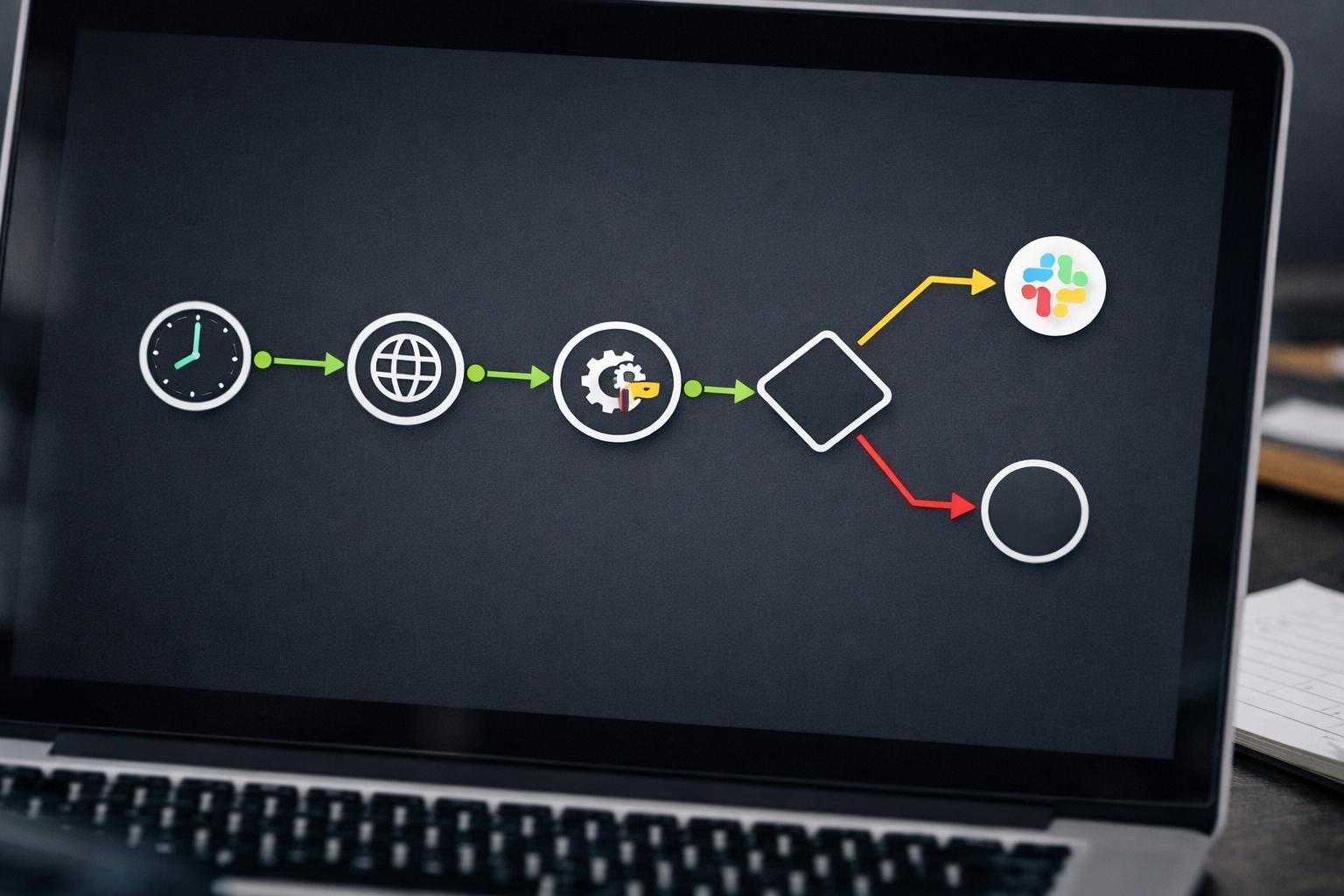
A practical n8n workflow runs on a schedule. The pattern used by teams building custom detection systems: Cron Trigger fires, HTTP Request Node fetches live content from your CMS, a Python Script Node runs comparison logic, an If Node routes based on threshold, and a Slack or webhook Node sends alerts. Green passes silently. Yellow logs a warning. Red triggers a notification with the specific drift metric, content ID, and a review link.
If running n8n in Docker, the Python Code Node may require environment variable adjustments, specific configuration requirements vary by setup and should be validated with a minimal test script before deploying the full pipeline.
Every alert must carry enough context for triage. A bad alert says "Drift detected." A good alert says "KL Divergence 0.62 on batch #1247. Affected assets: 14 of 200. Top divergent terms: 'leverage', 'game-changing', 'unlock potential', 3.2x baseline frequency."
Define thresholds you'll act on: KL Divergence above 0.50 for voice/tone, metadata staleness above 15% for structure, CTR drop > 5% or AI accuracy drop > 3% for downstream impact, and PSI bands of green (< 0.10), yellow (0.10, 0.25), red (> 0.25).
When a threshold trips, run a standardized investigation. Common root causes: someone updated a CMS template without updating the baseline schema, a batch of new contributors hasn't internalized the style guide, an LLM provider update shifted model behavior, leadership changed positioning legitimately but nobody updated the baseline, or a plugin update altered output characteristics. Document which causes repeat and address them structurally, if template changes trigger 60% of alerts, add pre-publish schema validation rather than relying entirely on post-publish detection.
For confirmed drift that represents actual degradation, retrain detection models with corrected examples. For false positives, adjust thresholds or whitelist patterns. Schedule calibration reviews monthly, without them, threshold fatigue sets in and alerts become noise.
Detection sitting in a sidecar dashboard that nobody checks is the same as having no detection at all.
The most effective pattern borrows from software engineering: content doesn't publish if it fails pre-deployment checks. CI/CD-style quality gates, adapted for content pipelines, insert automated validation between "draft complete" and "published." A piece passes through tone scoring, structural validation, and terminology compliance before reaching the CMS. If it fails, it routes to review rather than going live. This catches drift before it reaches your audience.
Your detection pipeline needs read access to published content and, for gating, write access to your publishing queue. The n8n integration catalog covers most CMS platforms natively; for anything else, the HTTP Request node handles custom API calls. When content is flagged and the author disagrees, route through a human-in-the-loop adjudication step where reviewer decisions feed back into threshold calibration.
Start by reading the flagged piece, does it actually read off-brand? Then audit your comparison method (embedding-based comparison often outperforms difflib for semantic work). Review threshold sensitivity: if 30% of flags are dismissed by reviewers, thresholds are too tight. Finally, check for batch effects, a single writer producing 40% of a batch can skew distribution metrics.
What works for 200 assets a month breaks at 5,000. Break your detection pipeline into independent, composable modules, tone detection, structure validation, terminology compliance, process auditing, each failing gracefully without taking down the entire system. At enterprise scale, fine-tune a model on your corpus using adjudicated drift examples as training data. The best practice for scaling is building continuous feedback loops: every adjudication decision feeds back into the model, every threshold adjustment is version-controlled, and every false positive is analyzed for patterns.
A B2B SaaS company publishing 800 articles per month across 12 contributors noticed reader complaints about inconsistent voice. After embedding 50 reference articles as a voice baseline, they deployed a weekly n8n workflow computing KL Divergence across production batches. Scores crossing 0.50 triggered Slack notifications to the managing editor. Flagged articles were adjudicated by a senior editor and decisions fed back into threshold tuning. Within three months, flagged articles dropped 40%, not because thresholds loosened, but because writers saw their scores, internalized the patterns, and self-corrected. The detection system became a coaching tool, not just an audit mechanism.
::cta{019ef14b-d36f-751d-5b17-4caafe573345}
The decision comes down to three questions. Do your content guidelines resist standardization? If your brand voice is nuanced and templates are complex, off-the-shelf tools will frustrate you, build custom. Do you have someone who can write Python and maintain n8n workflows? If not, start with Acrolinx or Writer.com and learn what metrics matter before investing in infrastructure. Do you need pre-publish gating or just post-publish monitoring? Off-the-shelf tools lean toward post-publish analysis; custom pipelines gate content before it goes live, which is where drift detection delivers its highest ROI.
For teams that need custom configurability but lack in-house engineering bandwidth, Hesham.us builds bespoke drift detection pipelines, using n8n, custom scripts, APIs, quality gating, and adjudication mechanisms, with 12-month aftercare for ongoing threshold tuning, debugging, and optimization. It's an option for serious content operations that have outgrown what SaaS governance tools handle alone.
If you're still in early stages, start with a free tier of an off-the-shelf tool and learn what you actually need to measure. If you're already at scale and feeling the friction of manual audits and inconsistent outputs, custom is the path that pays off. The five-step framework, Baseline, Monitor, Flag, Analyze, Calibrate, works regardless of which tooling you choose. What matters is that you start measuring before the drift becomes the norm.