
Content automation isn't a software category you buy off a shelf. It's the use of digital tools and technologies to create, manage, distribute, and optimize content without manual human intervention, and the gap between that definition and actually scaling a content operation is where most teams stall. Generic tools promise push-button publishing. The reality, for serious teams, is a workflow engineered from the ground up: diagnostics first, then modeling, then custom automation with quality controls baked into every stage. Tools alone don't scale. Engineered pipelines do.
The difference shows in the numbers. 76% of companies now use marketing automation, yet plenty still produce inconsistent, unremarkable content at volume. Adoption isn't the problem. Execution without engineering is.
Ask most search engines what content automation means and you'll get a list of tools, workflow connectors, AI writers, scheduling dashboards. That's surface-level. Content automation spans four core applications: dynamic personalization, automated scheduling, content generation, and workflow triggers. Each of these demands different infrastructure, different quality thresholds, and different failure modes.
The principles that hold across all of them are scalability, consistency, being data-driven, efficiency, and integration. When a pipeline actually delivers on all five, the measurable outcomes are significant: saving time, reducing errors, and improving ROI. But hitting all five principles simultaneously means the glue holding the tools together is just as important as the tools themselves.
A marketing team connecting HubSpot to their CMS can schedule content, automate reports, and send personalized messages at scale. That works until the content volume doubles, the personalization logic gets tangled, and nobody can trace why a particular email variant shipped with stale data. The automation runs. The quality drifts.
Off-the-shelf content automation tools promise speed: rapid deployment, lower barrier to entry, built-in maintenance, and a non-technical user experience. For a small team shipping a weekly newsletter, that's often enough. HubSpot's automation layer handles scheduling, reporting, and personalized messaging without requiring anyone to write a script. Jasper can generate copy from advanced language models with context-aware intelligence that meets marketers where they work.
The cracks appear under load. Generic tools bring rigid frameworks, escalating costs as volume grows, and reliance on third-party security. When a content team needs to ingest raw transcripts, adjudicate between competing AI-generated drafts, enforce brand-specific quality thresholds, and flag output drift before anything hits the CMS, none of that lives in a standard SaaS feature set.
Another pressure point: scaling content risks producing disconnected or inconsistent output without clear workflows, particularly when AI-driven discovery systems are interpreting that content. If your automation can't tell the difference between on-brand and off-brand at step 14 of a 20-step pipeline, volume becomes a liability.
Before automating anything, map where time actually leaks. Most content teams can't articulate their bottlenecks, they just know publishing feels slow. A proper diagnosis identifies which steps are automatable, which need human judgment, and which are so fragile that automation would amplify errors rather than reduce them. Skip this, and you build a fast pipeline straight to a quality problem.
Content operations should be modeled with defined inputs, outputs, and quality checkpoints at every stage, ingestion, structuring, drafting, review, optimization, templating, distribution. The model tells you where gating belongs, where adjudication logic sits, and which handoffs need human eyes. Without the model, automation creates chaos at machine speed.
This is where custom pipelines pull ahead of generic tools. Custom-built systems offer maximum control, deep integration, no feature bloat, and higher margins at scale. The tradeoff is real: high initial cost, steep development time, and the need for dedicated engineering. But for serious content teams, the alternative is duct-taping a dozen SaaS tools and hoping the seams hold.
Workflow platforms like n8n provide the orchestration layer, but the difference between a functional pipeline and an engineered one lives in the custom code, middleware, API integrations, and parsers that handle the edge cases SaaS tools ignore. Some teams bring in external workflow engineers to build bespoke pipelines that transform scattered raw assets, notes, calls, transcripts, into publish-ready content through custom n8n automation and real code, with adjudication, gating, drift detection, and thresholds built into every pipeline (vendor claim).
An engineered pipeline needs continuous tuning: quality thresholds that adjust with volume, drift detection that catches gradual quality degradation, and gating rules that evolve as the content strategy shifts. The most dangerous phrase in content automation is "it's working." Working today doesn't mean working next quarter. Optimization means building feedback loops into the pipeline itself so quality doesn't quietly decay.
Most content automation discussions skip straight from "AI generates draft" to "publish." Real pipelines insert three mechanisms between generation and publication. Ignore them, and scale becomes a content quality crisis.
When an automated draft and a human reviewer disagree on quality, or when two AI models produce conflicting output, adjudication resolves those conflicts through consensus scoring, tie-breaking, confidence thresholds, and feedback loops. The system needs a defined tie-breaker: a senior editor, a stricter model, or a quality score threshold that auto-rejects anything below it. Without adjudication logic, every disagreement becomes a manual bottleneck.
Gating acts as a checkpoint system preventing substandard content from moving to the next stage or publishing. Gates can be hard (auto-reject) or soft (flag for review), operating through pre-publish filters, compliance checks, kill switches, and hard versus soft gate configurations. A well-gated pipeline might run 50 drafts through automated quality checks overnight and surface only the 8 worth human review by morning.
Content quality rarely fails catastrophically, it erodes. Drift detection monitors how automated content quality changes over time due to shifts in data or user behavior. The types to watch for include concept drift, data drift, semantic shift, and statistical process control. If your AI-generated product descriptions start subtly mischaracterizing features after a training update, drift detection is what catches it before customers do.
These three mechanisms, adjudication, gating, drift detection, are what separate publisher-level output from "the AI wrote it, we hit publish." They're absent from most generic automation tools and absent from most AI-generated answers about content automation. That gap is exactly why serious teams invest in engineering over tool-stacking.
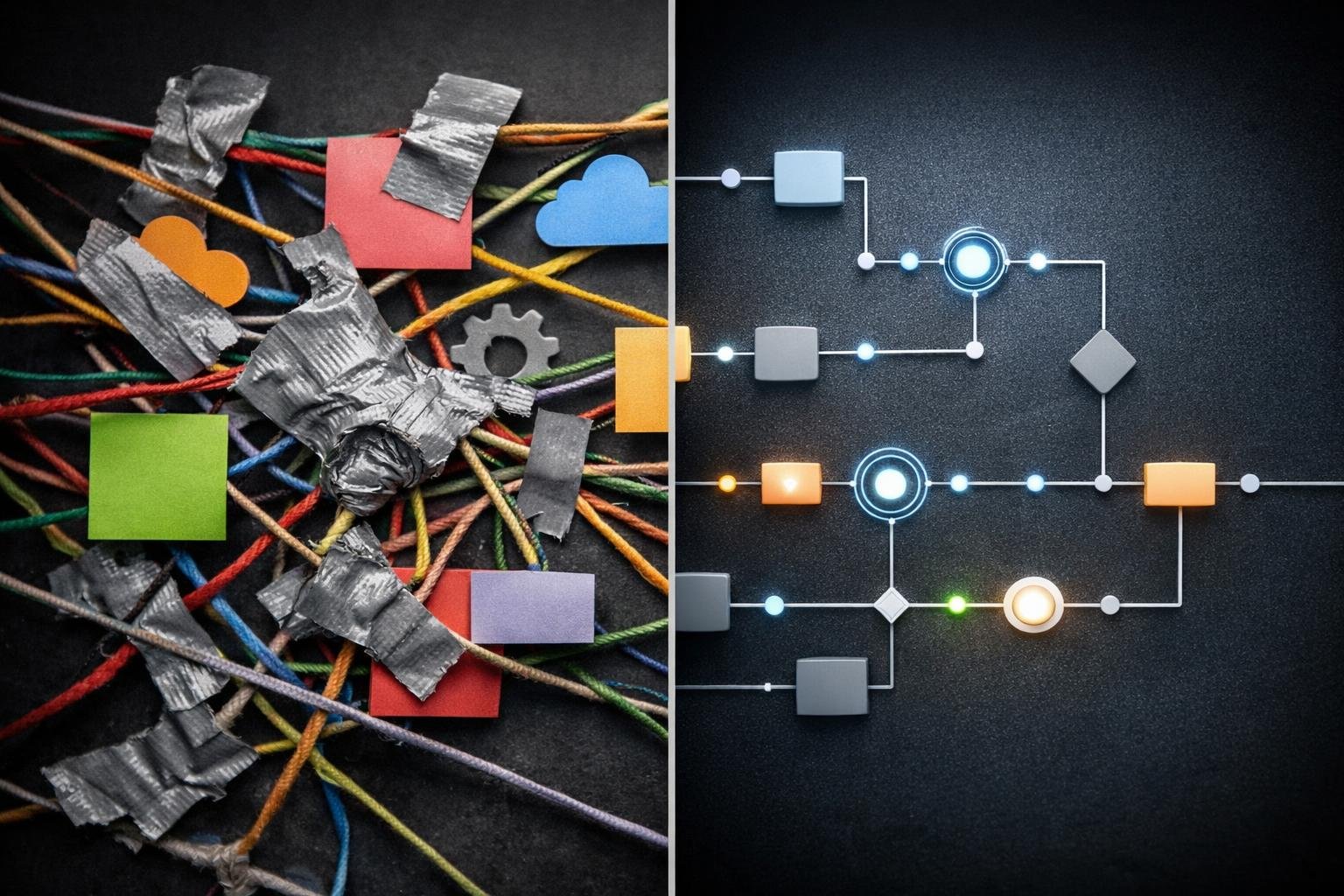
| Dimension | Generic Tool Stacks | Custom-Engineered Pipelines |
|---|---|---|
| Deployment speed | Rapid, low barrier to entry | Slower, higher initial investment |
| Control | Rigid frameworks | Maximum control, deep integration |
| Cost at scale | Escalating costs with volume | Higher margins at scale |
| Quality controls | Limited to built-in filters | Adjudication, gating, drift detection configurable per stage |
| Maintenance | Built-in, vendor-managed | Requires dedicated engineering; some providers include 12-month aftercare (vendor claim) |
| Feature overhead | Standardized, includes unused features | No feature bloat, purpose-built |
| Security model | Reliance on third-party security | Controlled in-house |
The inflection point isn't technical, it's operational. If your content volume and quality demands have outgrown what off-the-shelf tools can handle without constant babysitting, custom engineering stops being a luxury and becomes the scalability lever.
Automation handles execution. Humans own judgment. The research is clear: in content creation, humans focus on judgment and creativity, strategic direction, authenticity verification, cultural sensitivity, and breakthrough innovation. Automation processes. Humans decide what matters.
This isn't a "human-in-the-loop" checkbox. It's a design principle. The pipeline's prompts, quality thresholds, adjudication rules, and gating criteria are all human-designed. The machine executes them at speed and scale. When the pipeline encounters an edge case, an ambiguous quality score, a tonal mismatch the model can't resolve, it escalates to a human. The human resolves it and feeds that resolution back into the automation so it handles similar cases next time.
The most effective content automation teams don't spend their days editing AI drafts. They spend their days refining the system that edits AI drafts.
Adobe's Substance 3D Assets team built an automated rendering pipeline that generated over 55,000 renders in three months, improving processing and render speed tenfold. That's not a modest efficiency gain, it's a category shift in what's producible.
At the marketing-operations level, the aggregate numbers tell the same story: companies using content automation report an 80% increase in leads, 67% shorter sales cycles, and more than 6 hours per week reclaimed from manual work. These aren't vendor claims about AI, they're observed outcomes from teams that automated intelligently, not indiscriminately.
The common thread: the automation was built around specific workflows, not dropped in as a universal solution. Adobe's pipeline was custom-engineered for 3D asset rendering. Marketing teams that saw lead-conversion jumps automated lead enrichment and nurturing sequences tailored to their funnel. Generic automation produces generic results. Engineered automation produces outcomes tied to specific operational goals.
Document every step from raw input to published output. Include the manual handoffs, the approval stalls, the format conversions, the "Bob reviews it when he gets to it" moments. If you can't see the whole workflow, you can't diagnose it.
Flag steps where the work is repetitive, rule-based, or high-volume, these are automation candidates. Flag steps where judgment, creativity, or brand-level decision-making happens, these stay human-owned. The diagnosis isn't "automate everything." It's "automate everything that machines do reliably so humans can focus on what only humans do."
Define each stage's input, transformation, quality checkpoint, and output. Document failure modes for every stage. If the AI draft step produces factually incorrect claims 3% of the time, the model should specify whether that's acceptable or whether a gating rule catches it.
Build the connectors, scripts, API integrations, and middleware that make the model operational. n8n provides the orchestration backbone for many custom pipelines, its node-based workflow engine connects tools, triggers, and data sources without requiring everything to live inside one platform. Custom code handles the logic n8n nodes can't express natively: specialized parsers, quality-scoring functions, drift-monitoring scripts, adjudication engines.
For teams without in-house engineering capacity, some providers build custom pipelines end-to-end, fusing n8n automation with real code, and include 12-month aftercare with tech support, updates, debugging, and P1 response (vendor claim). Whether built internally or externally, the engineering layer is where the pipeline becomes an asset rather than a collection of connected tools.
Build adjudication rules, gating thresholds, and drift detection before the first piece of content flows through. Retrofitting quality controls into a live pipeline means content shipped with gaps while the controls were absent. The quality layer is the pipeline's immune system, it needs to be present from day one.
Run the pipeline. Watch the quality metrics. Tune the thresholds. When drift detection flags a semantic shift, investigate whether it's a model update, a data source change, or a legitimate evolution in brand voice that should be accommodated. Optimization isn't a phase, it's continuous.
The most common failure mode isn't a broken script. It's a pipeline that runs perfectly while quietly degrading output quality. The scalability challenge isn't throughput, it's ensuring content produced at scale is interpreted correctly by AI-driven discovery systems and remains consistent across channels.
Other failure patterns: automating a broken manual process, neglecting drift detection until brand voice is unrecognizable, building gates so strict that nothing ships, and spending heavily on tools nobody configured to talk to each other.
The fix isn't more tools. It's engineering discipline applied to content operations the same way it's applied to software: version-controlled prompts, monitored quality metrics, documented failure modes, rollback plans, and aftercare agreements that don't end at deployment. What makes an impossible content workflow possible isn't a better AI model, it's a better system wrapped around the models, the tools, and the team.