An Autonomous AI Avatar Engine for Short-Form Investing Video
A 234-node autonomous n8n pipeline that researches, scripts, voices, animates, and publishes a daily AI-presenter investing video to YouTube and TikTok — entirely on self-hosted infrastructure.
THE BRIEF
What the system needed to do.
This project is a fully autonomous, self-hosted pipeline that produces and publishes daily short-form investing videos fronted by a consistent AI presenter. Built as a 234-node n8n workflow, it detects trending financial news via SerpAPI, selects the most viral-worthy story, scripts it in a fixed host voice, and synthesises expressive narration with Fish Audio S1. It then segments the script, dynamically selects Creatomate layouts, generates visuals with Gemini, animates a lip-synced avatar via Kling AI, assembles the video with ffmpeg, optimises YouTube SEO, and publishes to YouTube and TikTok through Late — all monitored by email failure alerts.
The scope
Build a hands-off pipeline that researches, scripts, voices, animates, and publishes a daily AI-presenter investing Short to YouTube and TikTok.
DESIGN CHOICES
What makes the build interesting.
Retail investors & finance viewers
Consistent AI presenter with expressive voice
Dynamic per-segment video editing
End-to-end multi-platform automation
THE ARCHITECTURE
Follow the flow.
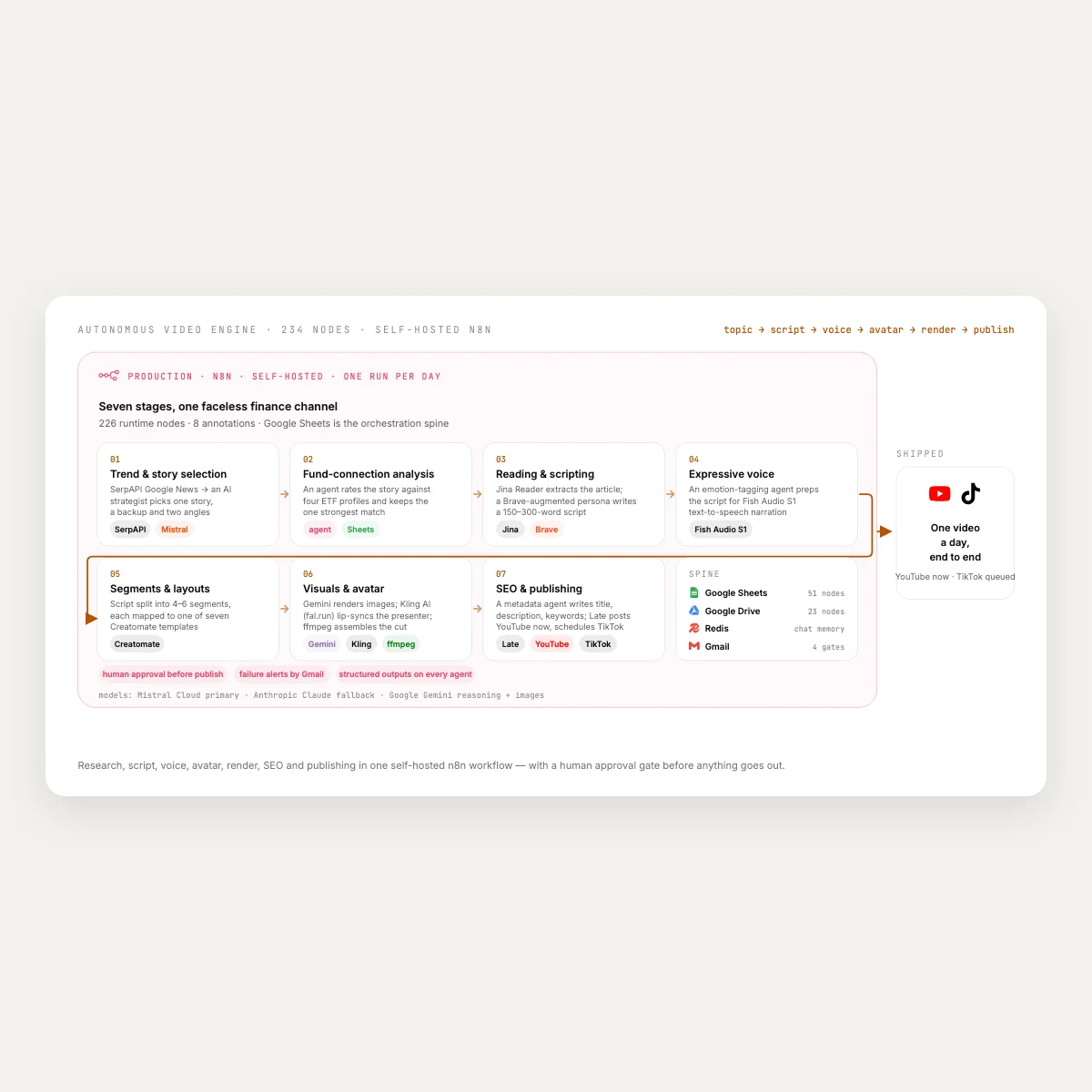
- Trend detection & story selection — SerpAPI Google News feeds an AI strategist that picks the most viral-worthy article plus a backup and two angles.
- Fund-connection analysis — an agent rates the story against four ETF profiles, assigning a single strongest match for a natural, non-forced mention.
- Article reading & scripting — Jina Reader extracts the source text; a persona scriptwriter (Brave-augmented) produces a 150–300-word teleprompter script.
- Expressive voice synthesis — an emotion-tagging agent prepares the script for Fish Audio S1 TTS, producing narration with real cadence.
- Segmentation & layout selection — the script is split into 4–6 segments, each assigned one of seven Creatomate templates with its required on-screen variables.
- Visual & avatar generation — Gemini renders images and Kling AI (fal.run) produces the lip-synced presenter; ffmpeg assembles the final video.
- SEO & publishing — a metadata agent optimises title, description, and keywords; Late publishes to YouTube immediately and schedules TikTok.
Tools and platforms
- n8n — workflow orchestration (234 nodes, self-hosted)
- SerpAPI / SerpApi — Google News story sourcing & YouTube SEO research
- Jina Reader — full-text article extraction
- Brave Search — live supporting-data lookups during scripting
- Mistral Cloud — primary LLM across most agents
- Anthropic Claude — fallback / high-reasoning LLM
- Google Gemini — chat reasoning and AI image generation
- Fish Audio (S1) — expressive text-to-speech narration
- Kling AI Avatar (via fal.run) — lip-synced presenter video
- Creatomate — templated video rendering (7 layouts)
- ffmpeg / ffprobe — final video assembly
- Google Drive — asset storage & sharing
- Google Sheets — orchestration spine & status ledger
- Redis — agent chat memory
- Late — multi-platform social publishing (YouTube + TikTok)
- Gmail — workflow failure alerts & approval gates
- Structured Output Parsers — schema-enforced agent outputs
What the design enables.
- Production-team output at zero marginal labour — a daily, polished, multi-platform Short that would normally require a researcher, writer, voice artist, editor, and social manager runs entirely unattended.
- Algorithm-tuned by design — story selection, scripting, and metadata are each optimised against short-form best practices (hook in two seconds, sub-60-second explainability, keyword-rich titles), maximising reach.
- Resilient, observable, and owner-controlled — a Google Sheets status ledger, email failure alerts with approval gates, and self-hosted infrastructure mean a complex twelve-service stack stays debuggable and under the owner's control.
The difficult parts.
- Robotic, lifeless narration. Default TTS flattens delivery and tanks retention. We added a dedicated tagging agent that inserts a controlled vocabulary of emotion and tone markers for Fish Audio S1, preserving the text exactly while giving the voice genuine cadence.
- Visual monotony across a long pipeline. A single repeated template makes every video feel identical. We built a two-agent layout system that selects from seven distinct Creatomate templates per segment and generates the precise variables each one needs.
- Silent failures in a 234-node chain. With this many interdependent stages, one broken step could derail the whole video unnoticed. We wired Gmail failure alerts with wait-for-response gates throughout, surfacing problems to the operator instead of failing quietly.
Build notes and context.
The brief: a faceless video studio that runs itself.
The client wanted to operate a short-form investing channel with the cadence and polish of a full production team — a daily YouTube Short and TikTok built around a single, recognisable on-screen presenter — without employing writers, voice talent, editors, or an uploader. The presenter is an AI persona with a fixed voice and personality: fast-paced, contrarian, anti-establishment, the kind of host who stops the scroll in two seconds. Every video also had to do quiet commercial work, surfacing one of four ETFs when — and only when — the story genuinely connected to it.
We delivered this as a 234-node n8n workflow, the largest and most complex build in this portfolio, orchestrating roughly a dozen external AI and media services into one continuous, self-healing assembly line. Like our other autonomous systems, it is split into discrete webhook-chained stages so each can be tested, retried, and reasoned about independently — essential at this node count.
Stage 1 — Trend detection and story selection. The pipeline pulls fresh financial headlines via SerpAPI's Google News endpoint, then an AI content strategist scores every candidate against five short-form criteria: timeliness, emotional hook, contrarian angle, broad appeal, and whether the core idea is explainable in under sixty seconds. It returns a primary pick and a backup, plus two distinct video angles — one scroll-stopping, one analytical.
Stage 2 — Fund-connection analysis. A second agent evaluates the chosen story against four ETF profiles, assigning exactly one "YES" (strongest link), optional "MID" connections, and "NO" to the rest — with a short pitch for how the winning fund could be woven in naturally. This gating is what keeps product mentions credible rather than spammy.
Stage 3 — Source reading and scripting. The article is fetched full-text via Jina Reader, stripped to clean body text by an extraction agent, then handed to the scriptwriting agent embodying the host persona. Augmented with live Brave Search for one or two fresh supporting stats, it writes a 150–300-word teleprompter-ready script in a consistent voice, choosing one of three opening styles and landing either a fund or a channel-subscribe call-to-action.
Stage 4 — Expressive voice synthesis. Because flat narration kills retention, a dedicated agent tags the script with a controlled vocabulary of emotion, tone, and audio-effect markers for Fish Audio's S1 TTS engine — calibrated to tag 30–50% of sentences while preserving the text character-for-character. The result is voiceover with genuine cadence and emphasis.
Stage 5 — Segmentation and dynamic layout. A "scissors not a pen" segmentation agent splits the script into 4–6 balanced segments without altering a single word. For each segment, a layout specialist selects from seven Creatomate video templates (talking head, image triptych, Q&A card, search-bar visual, bold statement, and more) based on the segment's tone and position, then a generation agent produces the exact on-screen text and image prompts each template needs.
Stage 6 — Visuals and AI avatar. Image prompts are rendered via Google Gemini image generation, while the presenter's segments are animated as a lip-synced talking avatar using Kling AI Avatar (via fal.run), driven by the synthesised voice track. Assets are assembled and stitched with ffmpeg, then stored and shared from Google Drive.
Stage 7 — SEO and multi-platform publishing. A metadata-optimisation agent runs live YouTube searches (SerpApi) to engineer a sub-70-character title, a hook-first description, and five tiered keywords. The finished video is then published through the Late API — uploaded immediately to YouTube and scheduled to TikTok — from the host's connected accounts.
Resilience by design. Google Sheets serves as the orchestration spine and status ledger across all stages, and Gmail "workflow failure" alerts with wait-for-response gates are wired throughout, so a failure in any single stage notifies the operator rather than silently breaking the chain. The entire system runs on self-hosted infrastructure, keeping a complex, multi-vendor media stack under the owner's control.
Have a related process in mind?
Tell me what goes in, what should come out and where the current process gets stuck.