
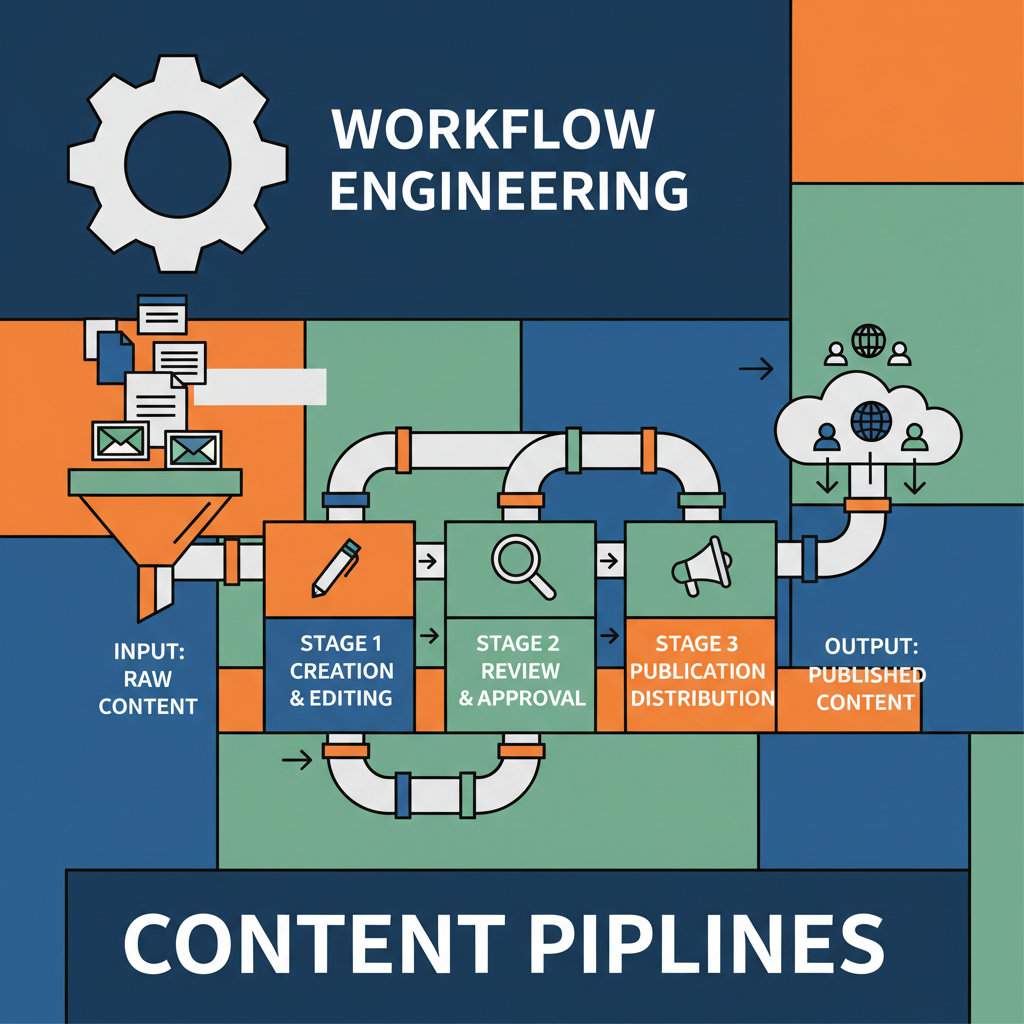
The article defines workflow engineering principles—durability, idempotency, separation of concerns, observability, deterministic defaults, and controlled flow—and explains why content pipelines break without them. It shows how checkpointing, safe retries, decoupled stages, quality gates, and pull-based flow prevent duplicate publishes and silent drift. It concludes with a five-check audit to diagnose durability, idempotency, decoupling, observability, and flow before re-architecting.
Workflow engineering principles are the structural rules (durability, idempotency, separation of concerns, observability, deterministic defaults, and controlled flow) that make a multi-step automation resilient, repeatable, and scalable rather than a fragile chain of connected apps. They originated in software and DevOps engineering to make durable execution that survives crashes, restarts, and infrastructure failures, and they apply directly to content production pipelines that move from raw notes to published articles. For content teams, these are not abstract ideals: they describe exactly why a Zapier chain that works for five articles breaks for fifty.
The core set engineers actually use breaks into six interlocking guarantees:
Each of these principles has a distinct meaning (and a distinct failure mode) once you apply it to a real content pipeline rather than an abstract task graph.
Durability and state preservation means a workflow engine persists execution progress so a transcript-to-article job that crashes mid-generation can resume from its last completed step without losing drafts or context. In engineering terms, durability ensures that workflows can process highly complex workflows, run indefinitely, or wait for action for hours or even days without losing data or state. For content teams this is a concrete, daily concern: it is the difference between losing a 45-minute transcription analysis when an LLM API times out and picking up exactly where it left off.
A brittle Zapier-style chain keeps state in memory. When step three fails, steps one and two are gone, the draft fragment is orphaned in a half-written doc, and the retry starts from zero and may publish twice. There is no checkpoint, no record of what succeeded.
An engineered content pipeline writes a checkpoint after each stage, transcript normalized, outline generated, draft written. AWS Lambda durable functions documents this pattern as a checkpoint and replay mechanism that tracks progress, skips completed steps on replay, resumes from the last checkpoint after unexpected termination, and can suspend execution for up to one year while awaiting external input.
Durability protects state; idempotency protects against the pipeline repeating itself.
Idempotency and separation of concerns are safety rails for multi-step content automation: idempotency means a failed publish step can be retried without creating a second live post or duplicate newsletter send, and separation of concerns means ideation, drafting, QA, and publishing run as decoupled, independently scalable stages instead of one monolithic script.
Idempotency = safe to retry. Engineering docs define it as operations where the effect remains the same regardless of how many times they run. AWS formalizes two execution semantics to enforce it: at-least-once per retry, which is safe only for idempotent operations, and at-most-once per retry, which is reserved for operations with external side effects such as charging a payment card or sending a one-shot SMS.
In a content pipeline, the CMS publish, newsletter API, and social post are at-most-once effects. A naive Zapier-style flow that retries on timeout will duplicate them. A properly engineered pipeline makes them idempotent with a stable key: generate a publish ID inside a checkpointed step, upsert to WordPress/Contentful with that ID, and pass the same idempotency key to the email provider. Retries then collapse to the same effect.
Separation of concerns = decoupled workers. The pattern is that the scheduler manages workflow timing and sequencing, while the worker focuses solely on task execution. Each stage owns one job and communicates via queue, trigger, or state record, not in-memory variables.
That split is why brittle content chains break. When briefing, research, drafting, QA, and publishing live in one script, a failure in QA kills the draft output and a spike in transcripts blocks publishing. With n8n paired with custom code, you can hold each stage as its own workflow (drafting scales on model APIs, QA scales on review triggers, publishing scales on CMS limits) without rewriting the chain. The result is easier to debug and expand, which is what it really takes to scale content automation.
Protecting state and isolating stages solves reliability, but content pipelines have a failure mode generic workflow engines don't: silent quality drift.
Observability and deterministic defaults in content pipelines means every AI-generated draft emits measurable quality signals and the pipeline defaults to a safe, gated state such as hold for review instead of silently publishing degraded output.
In engineering terms, observability is the ability to understand a system's internal state from its external outputs via three pillars of telemetry: metrics, logs and traces. For content, those translate to quality scores over time, structured logs of prompts, models and revisions, and traceable paths from source note to published article with full audit trails.
Deterministic control builds on that visibility. Fail-safe defaults require a conservative baseline: deny, stop, degrade safely, with predictable transitions to defined safe states and observable mode changes that emit telemetry. In a content context, a predictable fallback avoids an abrupt crash: the system will block publish, route to human adjudication, or revert to last approved version with an alert attached.
Without these, failure looks like quiet drift: tone slipping from the style guide, factual inconsistency after a model swap, SEO structure weakening. With them, a threshold breach pauses the queue, surfaces why, and preserves evidence.
Hesham.us Automated Content Pipelines illustrates the pattern in practice with built-in quality gating, configurable thresholds, adjudication between evaluators, and drift detection rather than silent auto-publish.
A pipeline that can't tell you when quality drifts isn't automated, it's just unmonitored.
There's one more class of principle that generic workflow-engineering advice underweights for content specifically: managing flow and bottlenecks across human and AI steps.
Flow bottlenecks and human-in-the-loop misplacement are where content pipelines break at scale. In content teams pushing 50+ articles per week through Zapier or Make chains, the failure point is rarely the AI writer; it is the unmanaged handoff between drafting, human review, and publishing that overwhelms reviewer capacity.
Flow engineering, borrowed from lean, treats work as pacing to capacity. Lean defines flow as smooth and continuous movement through the production line that minimizes delays and cycle times, and a pull system as production driven by actual downstream demand rather than forecast, minimizing waste. Applied to content, that means not pushing every auto-generated draft into Slack, but pulling the next draft only when an editor slot is open or an API quota window is free.
The tightest constraint moves. One week it is an approval queue with 30 drafts waiting, the next it is an LLM provider throttling, the next it is WordPress publishing limits. Lean practice is to continuously identify and eliminate that single bottleneck rather than add more push automations that pile up behind it.
Human-in-the-loop compounds this. DIY chains insert manual work everywhere (status checks, copy-paste approvals, email forwards) burning attention on logistics instead of judgment. Engineered design restricts human touch to genuine decisions: approve angle, adjudicate a low quality score, confirm brand risk. Everything else stays machine-routed.
| Criterion | Naive No-Code Chain (Zapier/Make-style) | Engineered Pipeline (n8n + Custom Code) |
|---|---|---|
| Flow control | Push every new draft forward on trigger, queue grows behind reviewer | Pull next job only when downstream capacity signals ready |
| State handling | In-memory run history, full re-run from start on crash | Persisted execution state with resume from last checkpoint |
| Retry / Idempotency behavior | Blind retry on failure risks duplicate publish | — |
| Quality gating | Manual spot-checks scattered across tools, no central gate | Central threshold gate that routes low scores to adjudication queue |
| Scaling ceiling / Maintenance burden | Breaks at API rate limits and human queue, brittle chain edits in UI | Rate-limited workers and bottleneck monitoring, custom code isolates changes |
Compared this way, naive chains track state in chat threads and retry blindly, while an engineered pipeline generally pairs retries with idempotency keys and state checks in n8n so it can resume a crashed transcript-to-draft run without duplicate publishes. With the principles and their failure modes mapped, the remaining question is how a team actually applies this checklist when building or auditing their own pipeline.
A pipeline audit checklist turns workflow engineering principles into five pass/fail checks you can run against your live content pipeline this week to see where it will break under load. Run this against the running system, not the diagram.
Not sure if HarperFlow is the right fit for you? Schedule a 15-minute call with Hesham and he'll answer all your questions.
If one check fails in isolation, patch it: add state persistence, deduplication keys, or a quality gate. If two or more fail and your team is adding manual fixes every week just to keep publishing, you are past patching. You need re-architecture that codifies what should and should not be automated.
That is the diagnostic mapping Hesham.us Automated Content Pipelines runs before any build, so you invest in structure instead of more duct tape.
Generate the key inside a checkpointed step after outline approval, for example content hash plus source note ID, and store it with execution state. Reuse the same key for CMS upsert and newsletter API so retries collapse because operations where the effect remains the same regardless of how many times they run do not duplicate.
A durable engine can suspend execution for up to one year while awaiting external input, so a draft can wait for editor review without losing progress. When the signal arrives it resumes from the last checkpoint and skips completed steps, as documented for AWS Lambda durable functions.
At-least-once per retry is safe only for idempotent operations like reading a transcript or generating a draft. At-most-once per retry is required for operations with external side effects such as charging a payment card, sending a one-shot SMS or a POST to a non-idempotent API like live publish.
Force-stop a run right after transcription or first draft and restart the worker. A durable pipeline resumes from the last completed step instead of restarting from scratch and keeps assets intact. If it restarts from zero, you are keeping state in memory.
You need the three pillars: metrics for quality scores over time, logs of prompts, models and revisions, and traces from source note to published URL. This maps to metrics, logs and traces and lets you alert when thresholds breach instead of auto-publishing degraded content.
Apply fail-safe defaults with a conservative baseline: deny, stop, degrade safely with predictable transitions to defined safe states and observable mode changes. For content that means block publish, route to adjudication, or revert to last approved version with an alert.
Use the separation pattern where the scheduler manages workflow timing and sequencing, while the worker focuses solely on task execution. Put ideation, drafting, QA and publishing behind queues or triggers with their own state records, so each scales independently.
Lean defines flow as smooth and continuous movement minimizing delays and pull as production driven by actual, immediate demand rather than forecasts. Pulling the next draft only when downstream capacity signals ready prevents queue growth behind reviewers. You can learn more in this pull system overview.